The Overwhelming Fear of Machines Taking Over
Have you ever stared at your screen, reading yet another headline about computers stealing our jobs, and felt a huge knot in your stomach? You aren't alone. Let's push past the wild sci-fi rumors and look at what these smart calculators actually do—and why your messy, unique human skills are much safer than you think.
This deep sense of anxiety is something I see everywhere right now. Normal, hardworking people are constantly bombarded with exaggerated social media posts claiming that artificial general intelligence is already secretly here. You open your phone, and a self-proclaimed tech guru is shouting that you will lose your job if you do not buy their course on how to survive the robot apocalypse.
This constant noise creates a terrible amount of mental stress for the average person. Small business owners are paralyzed, unsure if they should hire new staff or wait for a magical software program to run their entire company. Parents look at their children doing homework and worry that going to college might be a massive waste of time and money if machines are going to do all the thinking anyway.
But I want you to take a very deep breath and relax. The stories you are seeing on social media are designed to grab your attention and scare you into clicking. When we actually look at the cold, hard science behind these computer programs, a completely different reality appears.
Before You Read On: 3 Quick Takeaways
- Current software models are just massive auto-complete engines, not thinking brains.
- Computers struggle with basic physical tasks that a two-year-old child finds super easy.
- Your empathy, real-world experiences, and creative thinking are your biggest advantages today.
Demystifying the Sentient Robot Narrative
To truly understand why you do not need to panic, we must look at how these massive computer programs actually function behind the scenes. We often assume that because a chatbot sounds incredibly human, it must be thinking like a human. This is the biggest illusion in modern technology.
Right now, we interact with systems that are exceptionally good at predicting the next word in a sentence. They have read billions of books, articles, and forum posts across the internet. When you ask them a question, they are running complex math equations to guess what a normal human response should look like.
They are not sitting inside the server room deeply pondering the meaning of your question. They do not have feelings, memories, or a sense of self-awareness. They are just highly advanced auto-complete engines, much like the one on your phone's keyboard, just on a much larger scale.
Quick Reality Check: Myth vs. Fact
- Myth: Chatbots actually understand the questions you ask them.
- Fact: They just guess the next best word using math. If you ask a bot to write a recipe, it doesn't know what food tastes like. It just knows the word "salt" usually shows up right after "a pinch of."
If you ask a current system to write a poem about a sad dog, it scans its massive database for words commonly associated with sadness and dogs. It strings them together using grammatical rules it learned through basic pattern recognition. It does not actually know what a dog is, and it certainly does not understand the feeling of sadness.
Pro Tip: I used to think these bots were basically human brains trapped in a computer, so I blindly trusted one to do some basic math for my monthly budget. I quickly realized my mistake when it confidently hallucinated a completely wrong number that made zero logical sense, proving to me that it could not actually reason at all.
The Illusion of Deep Understanding
The reason we get tricked into believing these machines are becoming sentient is due to our natural human tendency to humanize things. When a car makes a weird noise, we say the car is "complaining." When a computer program speaks to us with perfect grammar and politeness, our brains immediately assume there is a conscious mind on the other end.
However, true reasoning requires a physical understanding of the world. A human toddler knows that if you drop a glass cup on a hard tile floor, it will shatter. The toddler understands gravity, fragility, and physical consequences through basic observation and existing in the real world.
A computer program only knows a glass shatters because a human wrote a sentence about it somewhere on the internet. If you put that same computer program in a brand new situation it has never read about, it completely falls apart. It cannot use common sense to solve a novel physical problem.
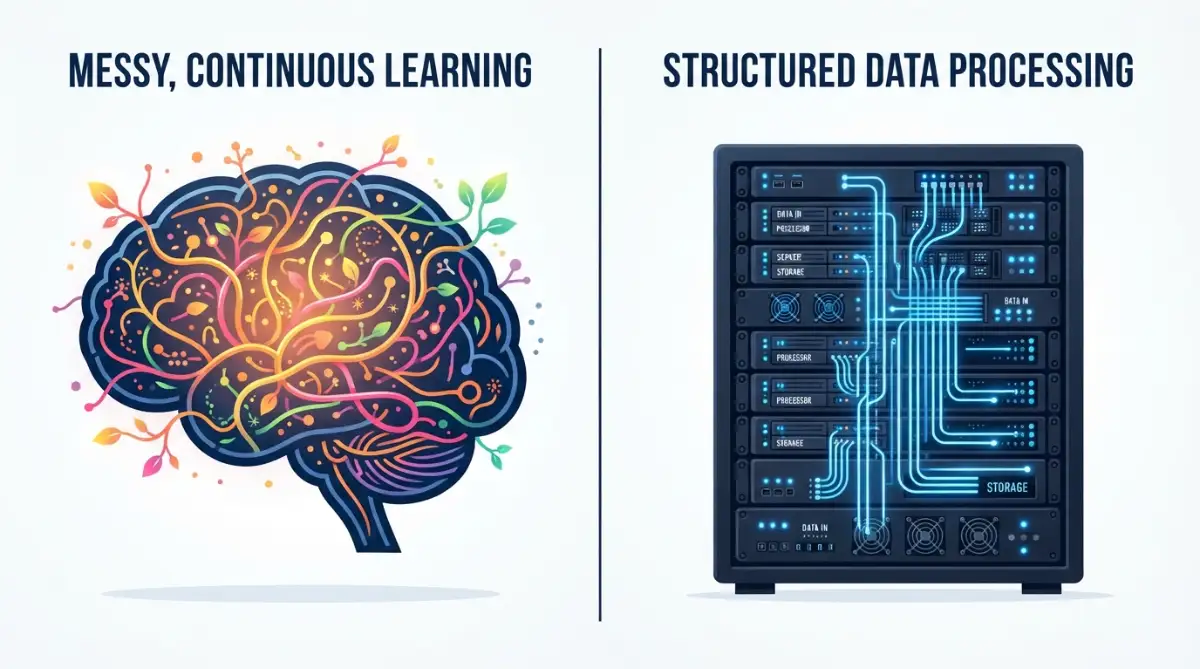
Check out this quick visual breakdown of how our brains process information entirely differently from a server farm.
Navigating the Memory and Context Wall
Another massive barrier preventing artificial general intelligence from becoming a reality today is the concept of continuous learning and long-term memory. As human beings, every single experience we have builds upon our past experiences. You remember the face of your favorite teacher, the smell of rain, and the painful sting of touching a hot stove.
Current machine models do not operate this way. When you close a chat window with a popular AI tool, its short-term memory of your conversation is completely wiped clean. It starts the next conversation with a blank slate, having learned absolutely nothing from your interaction.
For a machine to reach true human-level intelligence, it would need the ability to learn continuously without forgetting everything else it knows. In computer science, there is a known problem where teaching a model new information causes it to rapidly forget old information.
Our human brains casually manage continuous learning while running on about twenty watts of power, which is less energy than a standard lightbulb. Meanwhile, training a large language model requires massive data centers pulling enough electricity to power a small city. We are hitting massive physical and energetic walls with our current hardware limits.
Recognizing the Difference Between Specialized and General
To clear up the confusion, we must separate the tools we use today from the sci-fi concept of general intelligence. Right now, humanity has mastered specialized, or narrow, systems. These are algorithms built to do one highly specific task incredibly well.
A medical algorithm can look at an X-ray and spot a tumor faster and more accurately than a human doctor. A chess program can beat the greatest human grandmasters without breaking a sweat. A navigation app can calculate the fastest route home by analyzing live traffic data from thousands of other drivers.
These are amazing, powerful tools that will change how we work and live. But the medical algorithm cannot play chess, the chess program cannot drive a car, and the navigation app cannot read an X-ray. They are restricted entirely to their tiny, specific boxes of programming.
Think of it like this:
Imagine you buy a high-end blender. It makes the perfect fruit smoothie in ten seconds flat. That is specialized technology. Now, try asking that same blender to chop firewood or fix your leaky sink. It completely fails. Just because a tool is incredible at one specific job doesn't mean it can run your whole life!
General intelligence means having the ability to learn any intellectual task that a human being can do. It means being able to write a symphony, fix a leaky pipe, understand a joke, and cook a meal. We are nowhere near combining all of these completely different types of understanding into one unified system.
A Quick Breakdown of Capabilities
To make this completely clear, let us look at exactly where the lines are drawn between what we have now and what people fear is coming. Understanding this difference is the best way to stop feeling anxious about the news.
The Moravec Paradox and Physical Reality
One of the most fascinating concepts in robotics and computer science is something called Moravec's paradox. Back in the early days of computing, researchers assumed that high-level reasoning, like playing chess or solving complex algebra, would be incredibly difficult for computers to master.
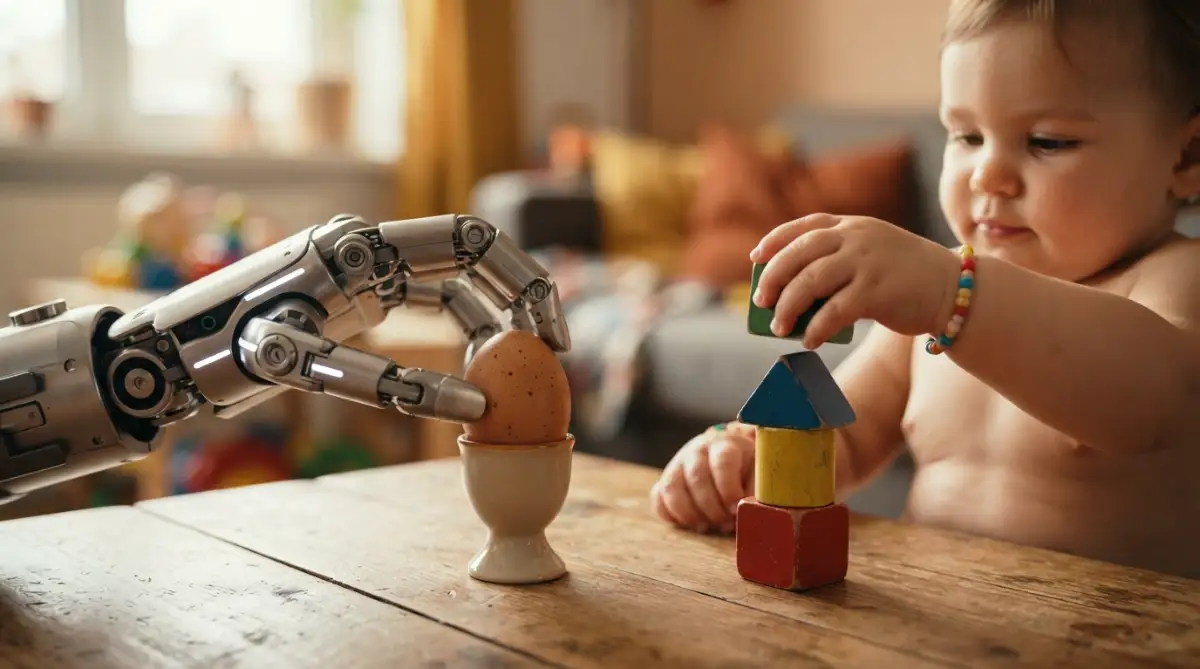
They also assumed that low-level sensorimotor skills, like walking up a flight of stairs or picking up a fragile egg without breaking it, would be very easy to teach a robot. After all, a two-year-old child can learn to walk, but they cannot do calculus.
It turns out the exact opposite is true. We created machines that can do complex math in a fraction of a second. But building a robot that can walk into an untidy kitchen, identify a dirty coffee mug, wash it in the sink, and put it on a shelf is an incredibly massive challenge that we still have not fully solved.
This paradox proves that human intelligence is deeply tied to our physical bodies and our interaction with the physical world. True general intelligence cannot just exist as a floating brain inside a server rack. It needs to interact with the physical world to understand context, space, and physical limitations.
Why the Hype Machine Keeps Spinning
You might be wondering why, if all these limitations exist, every news channel and tech company keeps saying general intelligence is right around the corner. The answer usually comes down to simple economics and the need for attention.
Tech companies are currently locked in a massive battle for investment money. To convince investors to give them billions of dollars for new server farms, they have to paint a picture of a magical future where their product can do literally anything. Promising a slightly better spell-checker does not bring in billions of dollars.
When you read a headline that says robots are coming for your job, you are almost guaranteed to click on it out of pure survival instinct. Once you understand that you are caught in a massive marketing loop, the fear begins to lose its grip on you. You can start looking at these tools practically, rather than emotionally.
Treating Algorithms as Smart Calculators
The healthiest way to approach modern technology is to view it as a highly advanced calculator for words and ideas. Just like the introduction of the pocket calculator did not make mathematicians obsolete, these new programs will not make human creativity and reasoning useless.
When calculators became widely available, math teachers panicked. They thought students would never learn to think again. Instead, calculators simply removed the boring, repetitive parts of arithmetic, allowing humans to focus on higher-level physics, engineering, and architectural problems.
You can use modern text and image generators to speed up the boring parts of your day. You can ask them to summarize a long, boring email thread. You can use them to brainstorm five different names for a new project. You can have them check your spelling and grammar before you send a professional document.
But you are always the one steering the ship. You provide the original idea, you fact-check the output, and you add the human empathy and context that the machine simply cannot provide. The human element—your unique perspective, your lived experiences, and your emotional intelligence—is becoming more valuable, not less.
The Value of Human Empathy
Think about the last time you had a horrible day and needed to talk to a friend. You did not just want someone to output logically correct sentences to solve your problem. You wanted someone to listen, to understand your pain, and to share a genuine moment of connection.
A machine can simulate empathy by generating words like, "I am so sorry you are feeling that way." But because you know the machine cannot actually feel sorry, the words are completely empty. Human connection requires mutual vulnerability, which a line of code can never possess.
In a world filled with artificial text and computer-generated images, genuine human experiences will command the highest premium. People will always crave real art created by real humans who have experienced real pain and joy. They will want to read stories written by people who have actually lived through the messy, beautiful reality of life.
Instead of fearing that a machine will replace you, focus on doubling down on the traits that make you uniquely human. Cultivate your empathy, your ability to build deep relationships, and your messy, out-of-the-box creativity. These are the areas where no algorithm can ever compete with you.
Mastering the Reality of Machine Learning Today
Now that we have cleared up the massive confusion between science fiction and actual computer science, it is time to look at how you can use this knowledge to your advantage. You do not have to hide from new technology, but you also do not have to worship it. I want to share some incredibly practical ways you can navigate this new era without losing your mind or your money.
By changing exactly how you interact with these tools, you take all the power back into your own hands. You become the director of the movie, rather than just a frightened audience member watching it happen. Let us break down a few smart strategies you can start using at your desk today.
Treat Algorithms Like Overconfident Interns
One of the best mental shifts you can make right now is changing how you view these chatbots. Imagine you just hired a brand new intern fresh out of college who has read a million textbooks but has absolutely zero real-world street smarts. That intern is eager to please you and will confidently guess an answer even if they are completely wrong.
You would never hand this new intern the keys to your entire business on their first day. You would give them small, repetitive tasks and double-check all of their work before sending it to a client. This is exactly how you need to treat modern smart algorithms.
They are fantastic at drafting a rough outline for a boring meeting or sorting a messy list of names into alphabetical order. But they do not understand the emotional weight of a situation. If you let them write an apology email to an angry customer without editing it yourself, they might sound incredibly robotic and make the situation much worse.
Always remember that you are the expert in your own life and career. Use the computer program to do the heavy lifting of gathering basic ideas, but you must apply your own unique human judgment to the final product.
The Art of Giving Clear Instructions
A huge reason people get frustrated with modern computer models is that they do not know how to talk to them properly. If you walk into a restaurant and just yell "food," the chef has no idea what to cook for you. The exact same rule applies when you type a command into a text generator.
If you give a lazy, vague command, you are going to get a lazy, boring answer back. You have to tell the machine exactly what role you want it to play, who the target audience is, and what specific tone you want it to use. I see so many beginners give up entirely just because they never learned the basics of fixing broken text prompts.
Instead of asking, "Write a post about healthy eating," try something much more specific. Tell the program, "Act like a friendly nutritionist and write a short, encouraging guide for busy parents who want to cook healthy dinners in under thirty minutes." The difference in the quality of the answer will completely shock you.
By practicing clear communication, you save yourself hours of frustration. You stop expecting the machine to read your mind, and you start acting like a skilled operator driving a powerful vehicle.
Building Reliable Income Without the Hype
There are thousands of videos right now telling you that you can become a millionaire overnight by letting a computer do all your work. I am here to tell you that this is a complete fantasy designed to sell you expensive online courses. However, you can definitely use these tools to build realistic, steady side projects.
Instead of trying to automate a magical money-making machine, use the technology to speed up normal, helpful tasks. For example, you can use these systems to brainstorm ideas for creating helpful digital workspaces that you can sell online. The machine helps you think of the ideas, but you put the actual templates together with your own human touch.
Real businesses are built on solving real problems for real people. A robot cannot sit down and deeply understand what a frustrated small business owner needs to organize their office. You have that human empathy, and you can use basic software to deliver your solutions much faster than you could before.
Focus on developing skills that combine your personal empathy with basic tech literacy. That unique combination is exactly what employers and clients are desperately looking for right now.
Focusing on Tangible Tech Improvements
When we get too caught up reading articles about digital super-brains, we often ignore the simple physical technology right in front of us. You do not need to understand quantum computing to make your daily life run smoother. Sometimes, the best tech upgrades are the most boring ones.
I used to stress about learning complex coding languages until I realized my own home network was a complete mess. Instead of worrying about robots taking my job, I spent a weekend just focusing on improving my home internet setup. Fixing the physical router in my hallway did more for my daily productivity than any fancy new software ever could.
We also often panic when basic things break, assuming the technology is getting too complex for us to handle. If your computer freezes, it is usually not a sentient virus; it is just a memory overload. Learning basic skills, like troubleshooting basic computer tasks, gives you a wonderful sense of control and confidence.
Keep your focus grounded in the physical world. A solid, reliable computer and a quiet place to work are much more valuable than spending hours testing out random software programs you do not actually need.
Dangerous Traps to Avoid When Using Smart Algorithms
While it is great to use these tools to save time, there are some very real dangers you need to watch out for. These dangers have nothing to do with machines taking over the world, but everything to do with bad human habits. If you fall into these traps, you can seriously damage your professional reputation and your mental health.
Let us walk through the most common pitfalls I see people stumble into every single day. Recognizing these mistakes early is the easiest way to protect yourself and your career.
Blindly Trusting Automated Fact-Checking
The absolute worst mistake you can make is assuming that a beautifully written sentence is automatically a true sentence. As we discussed earlier, these systems are just predicting words; they do not actually know what those words mean. They will confidently invent fake historical dates, fake math equations, and fake scientific studies.
If you copy and paste an answer from a chatbot into a business report without checking the facts, you are playing a very dangerous game. Your boss or your client is eventually going to catch the mistake, and the blame will fall entirely on your shoulders. You can never tell an employer, "The computer told me it was true," as an excuse.
You must always remain the final editor of anything you put your name on. I highly recommend cross-referencing any important data points with trusted educational sources or recent studies on human-centered algorithm design to ensure you are operating with safe, accurate information. Think of the software as a messy rough draft, never the final answer.
The Complete Loss of Your Unique Voice
There is a strange, boring sameness slowly taking over the internet. Because so many people are relying on the exact same software to write their emails, blogs, and social media posts, everything is starting to sound exactly the same. The language is overly polite, extremely long-winded, and completely stripped of human personality.
If you let a machine write every single message you send, you slowly erase your own personality from your work. Your clients and friends like you because of your unique sense of humor, your specific way of explaining things, and your personal stories. A computer program cannot replicate the funny thing that happened to you at the grocery store yesterday.
When you lose your voice, you become completely replaceable. If your writing sounds exactly like a robot, an employer might as well just use the robot and save money. To stay relevant, you must inject your own messy, human perspective into everything you create. Use slang, share personal failures, and tell real stories that only you can tell.
Handing Over Your Private Information
In the rush to try out every new digital assistant, we often forget basic common sense regarding our personal privacy. When you type information into a free online chat window, you are essentially handing that data over to a massive tech company. They use your conversations to train their future software models.
I have seen people accidentally paste highly confidential business documents, personal financial details, and even their home addresses into these tools to get a quick summary. This is a massive security risk. Once that information leaves your computer, you have zero control over where it ends up or who might eventually see it.
Treat these public software programs the same way you would treat a crowded coffee shop. You would not stand up and shout your bank account password to the entire room. Take the time to understand the importance of securing your digital home network and keeping your private data strictly on your own physical devices. It is always better to manually sort a private document than to risk a data leak.
For those running businesses, familiarizing yourself with understanding standard AI risk management protocols is a smart way to ensure your entire team stays safe. Set firm rules about what information is allowed to be shared with external software.
The Endless Trap of the Hype Cycle
Finally, please avoid the trap of constantly buying new tech products out of pure fear. Marketers are heavily playing on your anxiety right now. They want you to believe that if you do not buy their specific monthly subscription, you will be left behind in the dirt while everyone else gets rich.
This causes extreme decision fatigue and financial stress. You end up with ten different software subscriptions that you barely know how to use, and your actual daily work continues to pile up. This constant state of panic is exhausting and completely unnecessary.
Instead of chasing every shiny new tool, pick just one basic, reputable program and learn how to use it well. Ignore the flashy YouTube videos screaming about the next big update. Your energy is much better spent mastering your own craft and adapting business strategies for modern automation at a slow, comfortable pace.
Clear Answers to Your Biggest Tech Worries
When a topic gets this loud and confusing, it is normal to have a lot of nagging questions floating around in your head. I want to address the most common fears I hear from people directly, without any fancy jargon or marketing spins.
Will a computer algorithm completely replace my current job?
No, a single algorithm is not going to walk into your office and steal your chair. What might happen is that the tools you use to do your job will change. A human who learns how to use new technology efficiently might take the job of a human who completely refuses to learn anything new. Your best defense is simply staying curious and willing to adapt.
Can smart machines actually feel emotions or have self-awareness?
Absolutely not. They do not have feelings, they do not get angry, and they do not have a secret agenda. They are purely mathematical engines running incredibly fast calculations based on human text. Any emotion you think you see is just an illusion created by your own brain trying to make sense of human-sounding words.
How do I prepare my kids for a tech-heavy future?
Teach them exactly what these machines cannot do. Encourage them to play outside, build physical things with their hands, and develop deep empathy for other people. The future will heavily reward strong communication skills, critical thinking, and the ability to solve complex, messy human problems. Focus on building their character, not just their coding skills.
Are we close to creating true artificial general intelligence?
Most credible scientists agree that we are nowhere near true general intelligence. We have hit massive roadblocks regarding how much physical electricity and computing power is required just to run current models. Creating a system that can actually reason and learn continuously like a human being is a completely different scientific puzzle that remains unsolved.
Stepping Into Tomorrow With Confidence
The constant noise surrounding modern technology is designed to make you feel completely overwhelmed. But once you peel back the dramatic headlines and look at the actual mechanics of these tools, the monster under the bed completely disappears. You realize that these are just very fast, very capable calculators for text and data.
You do not need to be a computer scientist to thrive right now. You just need a heavy dose of common sense and a willingness to protect your own unique human value. Start treating these programs as helpful assistants rather than magical wizards. Check their facts, protect your private data, and never let them silence your authentic voice.
By taking these small, practical steps, you can instantly lower your daily stress levels. You can completely ignore the fear-mongering gurus and start using technology to actually make your life a little bit easier and a lot more productive.
My personal advice to you: I spent months feeling terrified that my writing career was completely over, but the moment I finally sat down and tested the software's real limits, my fear turned into relief. I highly encourage you to stop reading the scary headlines today, open up one of these basic tools, and ask it to do something incredibly mundane like organizing your grocery list; you will quickly see exactly who is really in charge.
Disclaimer: The information provided in this article is for educational and informational purposes only. It does not constitute professional career, financial, or technical advice. Technology is constantly changing, and you should always conduct your own research and consult with certified professionals before making significant changes to your business operations or data security practices.