The Hidden Trap: When Smart Tools Misread Your Rights
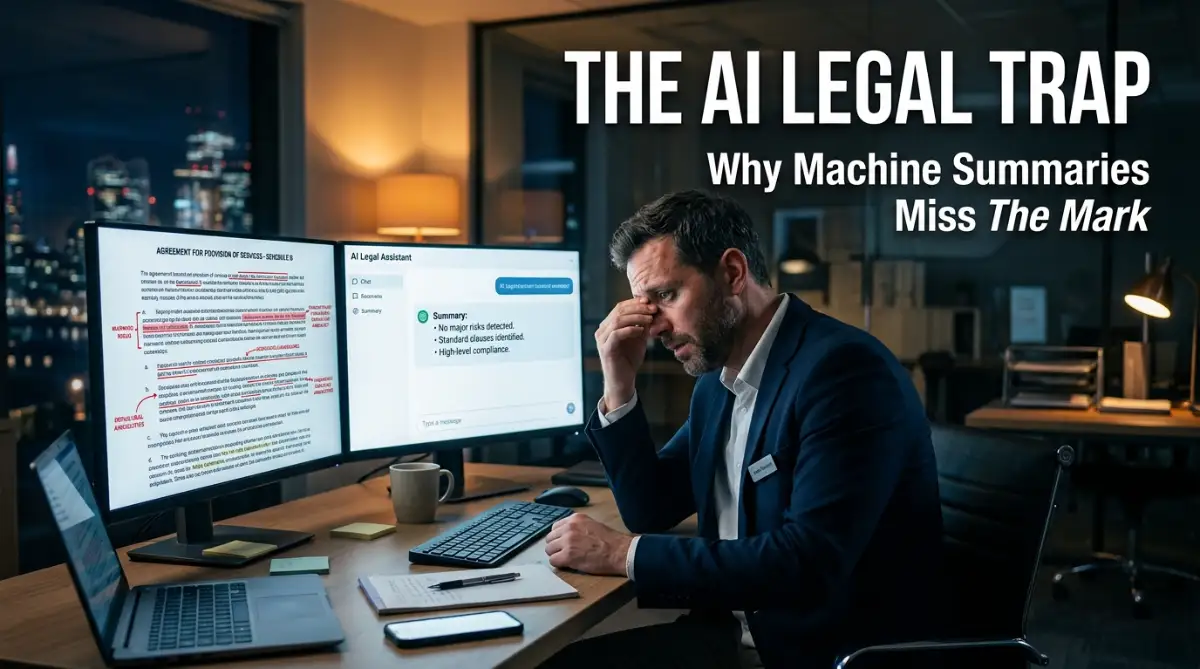
Have you ever signed a document just because a software tool told you it was totally safe? I did exactly that last year, and it nearly wiped out my entire business account. We all want to save money on legal fees by using smart algorithms to summarize dense contracts, but what those tools leave out can secretly ruin you. Let me show you exactly where these digital helpers fail and how you can actually protect your hard-earned money before you sign your next agreement.
But I was completely wrong. When I tried to use my own templates for a different project later, that first client threatened to sue me. The automated tool had completely misunderstood a tricky indemnity clause hidden on page forty-two. It summarized the basic payment terms perfectly but entirely skipped the part where I handed over exclusive rights to every single idea I used during the project. I lost weeks of sleep, spent a fortune trying to fix the mess, and realized a hard truth about leaning on algorithms for serious decisions. My attempt to save a few hours almost cost me my entire business.
But this convenience comes with a terrifying cost to your peace of mind. Algorithms are trained to predict words, not to protect your future. When regular folks use these systems to translate legal terms, they operate under a false sense of security. They sign non-disclosure agreements, commercial leases, and employment contracts thinking they are safe.
Then reality hits. A landlord evicts them over a clause the software ignored. A boss claims ownership of their side hustle. The heavy weight of legal trouble crashes down on them, bringing extreme anxiety, financial drain, and a deep sense of betrayal. The very tool meant to make life easier ends up creating a massive, stressful nightmare.
You should absolutely use modern tech to help you work faster, but you have to know where it fails. Legal language is not just a collection of words; it is a careful system of conditions, exceptions, and specific human intentions. Algorithms look for patterns. Lawyers look for loopholes. If you rely completely on machine-generated summaries, you are leaving your most important rights entirely to chance.
Must-Read Takeaways Before You Sign:
- Algorithms often guess the meaning of unfamiliar legal terms instead of giving you the exact legal definition.
- Smart tools cannot tell you if important safety clauses are completely missing from your contract.
- Uploading private business agreements into free software can cause severe, accidental data privacy leaks.
- Use tech as a fast search engine to find specific words (like "fee" or "terminate"), not as a final decision-maker.
Why Machine Logic Struggles with Human Laws
Understanding exactly where automated tools drop the ball is the first step to protecting yourself. Artificial intelligence is amazing at drafting emails or brainstorming marketing ideas, but legal documents require a completely different type of thinking.
When you feed a contract into a machine, it scans for familiar phrases and common paragraph structures. It tries to give you a "gist" of the document. However, the law does not operate on general ideas.
One single comma in a legal sentence can change the entire meaning of an agreement. A machine might summarize a section by saying, "You can cancel the contract at any time." What it might leave out is the second half of that sentence in the original document: "...provided you pay a penalty fee equal to six months of service."
This happens because the software prioritizes making the text readable over making it legally accurate. It wants to give you a clean, simple answer. But the law is rarely simple. It is full of complex "if-then" scenarios that depend heavily on context.
Algorithms also lack jurisdictional awareness. A contract signed in California might have completely different legal requirements than one signed in London. A human lawyer immediately checks which local laws apply to the agreement. A smart tool just reads the text in front of it, completely blind to the real-world rules governing your specific location.
The Illusion of Comprehension
We often assume that because an automated response sounds confident, it must be correct. These systems are designed to sound highly authoritative. They use polite, professional English that easily builds trust.
But this confidence is just an illusion. When these systems encounter highly unusual or highly specific clauses, they often experience "hallucinations." They essentially guess the meaning based on similar documents they have seen in their training data.
If your contract contains a unique arrangement that the software has never seen before, it will just make up a summary that sounds plausible. You will read it, nod your head, and sign away your rights, never knowing the tool completely guessed the answer.
A Quick Reality Check: What Algorithms Actually Miss
- Implied Obligations: Things you are forced to do that aren't clearly spelled out in plain text.
- Missing Protections: The tool will never warn you if a standard safety clause is completely absent from the page.
- Jurisdiction Traps: It completely ignores whether the contract forces you to go to court in a different state or country.
Pro Tip to remember: I have made it a strict rule in my own business to never let an algorithm read the "Termination" or "Liability" sections of any contract. I will use tech to summarize the scope of work, but I always read the penalty clauses with my own two eyes. It is the only way I can sleep peacefully at night.
Why Human Review Will Always Beat Automated Scans
If you want to see exactly how subtle word changes can completely alter a contract, check out this great breakdown from an actual legal professional.
Myth vs Reality in Legal Tech
Let us clear up some common misunderstandings about what these tools can actually do for you right now.
Myth: The software understands the meaning of the legal terms.
Reality: It only understands the statistical relationship between words. It does not actually "know" what a breach of contract means in the real world.
Myth: If the summary includes bullet points, it captured all the main ideas.
Reality: Bullet points often strip away the exceptions and conditions that protect you from being sued.
Myth: The tool can replace an expensive attorney for basic agreements.
Reality: It can help you organize your thoughts before talking to an attorney, but it cannot offer actual legal advice or strategy.
You only need the contract when there is a disagreement, a missing payment, or a broken promise. At that exact moment, the tiny details become the most important things in your life. A machine summary prepares you for the best-case scenario, while a human reading prepares you for the worst-case scenario.
A Quick Breakdown: Human vs Machine Review
To really understand the gap in quality, let us look at how both sides handle a complex legal concept like "Indemnification."
Notice the third point in that table. This is perhaps the biggest blind spot of all.
An automated system can only analyze the text you give it. If a sneaky client removes a standard protection clause from an agreement, the software will not flag the missing text. It will simply summarize what is there.
A human expert knows what should be in the document. They will look at an employment agreement and say, "Wait a minute, there is no severance clause here." A machine will never point out the empty spaces.
The Danger of Losing Cross-Referenced Meanings
Long documents are deeply connected webs of information. Section 2 might define a term, and Section 14 might change how that term is applied in an emergency.
When you ask a system to summarize a forty-page document, it often processes the text in chunks. It might forget the specific definition created on page two by the time it reaches page thirty.
This leads to disjointed, contradictory summaries. You might read a summary that says you get paid within thirty days, but the system missed the cross-reference in Section 9 that says payments are paused during an investigation.
How to Safely Combine Tech with Human Oversight
You do not have to throw away your smart tools completely. You just need to change how you use them. Treat these systems like a highly enthusiastic intern who means well but lacks real-world experience.
Instead of asking the tool to "summarize this contract," give it highly specific, narrow tasks.
Ask it to list all the dates mentioned in the document. Ask it to pull out every sentence that contains the word "penalty" or "fee." Use the tool to find the needles in the haystack, but do not ask it to explain the haystack to you.
When you use the software as a search engine rather than a decision-maker, it becomes a powerful asset. You can quickly locate the payment terms and then read those exact paragraphs yourself.
Always print out or digitally highlight the original text for the most sensitive areas of your life. Anything involving your health, your home, or your primary source of income requires manual reading.
Remember, if a dispute goes to court, a judge will not care that your digital assistant gave you a bad summary. You are legally bound by the words on the actual paper you signed.
Taking an extra twenty minutes to slowly read the difficult text might feel frustrating today. But that minor frustration is nothing compared to the overwhelming stress of fighting a legal battle you never saw coming.
Protect your time, but more importantly, protect your rights. Keep the machines in their place, and always trust your own eyes when it matters most.
Mastering the Balance: Smart Ways to Blend Technology with Human Oversight
Now that we understand the hidden dangers, you might be wondering how to actually use these modern tools without putting yourself at massive risk. The secret is not to abandon technology entirely. Instead, you just need to completely change your relationship with it.
Think of smart algorithms as a very fast but completely inexperienced assistant. You would never let a brand-new intern sign a massive business deal without checking their work first. You need to treat your software with that exact same level of professional suspicion.
One of the best ways to protect yourself is to change the specific commands you type into the machine. Instead of asking the tool to simply "summarize this contract," give it highly targeted, microscopic tasks. Ask the software to extract all sentences containing dates, dollar amounts, or the word "liability."
By doing this, you are forcing the machine to act as a powerful search engine rather than a decision-maker. You let it find the hidden needles in the haystack. Once it finds those specific sections, you can sit down and carefully read the original text with your own two eyes.
This approach saves you hours of reading useless filler text while keeping you in total control of the final meaning. If you rely on software to automate everyday administrative tasks with RPA basics, you already know that dividing tasks logically is the key to working smarter.
The Silent Danger of Data Privacy Leaks
There is a massive secret that most people completely ignore when they upload documents into a free online generator. When you paste your private business agreement into a public chat window, you might be breaking the law.
Most non-disclosure agreements strictly forbid you from sharing the contents with unauthorized third parties. Well, feeding that text into an open machine learning model usually counts as sharing it with a third party. The system might use your highly sensitive business secrets to train its future answers.
Imagine finding out your biggest client fired you because they caught you leaking their upcoming product details to a public algorithm. This happens much more often than people want to admit. To protect yourself, always review the data privacy settings of any tool you use.
If you are using custom internal systems, make sure you set up sustainable naming conventions for automated webhooks so your private legal documents never accidentally mix with public-facing data. Privacy is just as important as accuracy when dealing with legally binding text.
For a deeper understanding of how to protect sensitive information, checking out the FTC guidelines on data security is always a smart move for any business owner.
Breaking Down Complex Jargon Safely
Another brilliant way to use these tools is for language translation rather than document summarization. Legal jargon is incredibly frustrating and designed to confuse normal people. Words like "indemnify," "severability," or "force majeure" can make your head spin.
Instead of asking the tool to summarize the entire page, copy just one confusing sentence. Ask the system, "Explain what this specific sentence means to a middle school student." This forces the tool to break down the complex vocabulary without losing the surrounding context of the entire document.
Once you understand the basic definition of the words, read the original paragraph again. You will suddenly find that the intimidating legal text makes perfect sense to you. This method empowers you to actually learn the basic principles of contract law rather than blindly trusting a machine to protect you.
Real-Life Rule of Thumb: Think of an automated summary like using a GPS that only knows major highways. It gives you the general direction, but if a bridge is out on a small local road, it will drive you right off a cliff. Always let the software find the location of the tricky clauses, but rely on your own brain to drive safely through the actual text.
Always keep a digital notepad open while you work. When the software helps you understand a weird phrase, write it down in plain English. Over time, you will build your own personal dictionary of legal terms, making every future contract much easier to handle.

The Dangerous Traps People Fall Into When Reviewing Contracts
When we are rushing to close a deal or sign a new lease, our brains naturally look for the easiest way out. This desire for speed creates massive blind spots. One of the biggest mistakes I see people make is falling victim to "confirmation bias" when using automated tools.
You usually already know what you want the contract to say. You want it to say the rent is affordable, the terms are fair, and you can leave whenever you want. So, when the machine generates a simple list that matches your hopes, you instantly believe it.
You do not question the output because it tells you exactly what you want to hear. This emotional trap stops you from looking deeper into the messy, uncomfortable details. You skip reading the original document because the summary feels safe and reassuring.
But what happens when things go wrong? A friend of mine recently used a smart tool to review a freelance agreement. The tool said the client would pay him within thirty days. What the tool missed was a tiny clause saying the thirty days only started after the client’s final board of directors approved the work.
He waited three months for his money, almost lost his apartment, and nearly went bankrupt. The machine was not lying, but it failed to provide the human context that tied the payment to a completely unpredictable event. This is why you must never let convenience override your common sense.
The Illusion of "Standardized" Boilerplate
Another huge pitfall is assuming that the boring stuff at the very end of a document is just "standard text" that does not matter. People often tell the software to ignore the last five pages of a contract to save time.
They assume things like jurisdiction rules or dispute resolution clauses are just copy-pasted nonsense. This is a terrible mistake. That boring text actually dictates exactly where and how you can sue someone if they steal your money.
If a company is based in New York but the contract says all disputes must be handled in a small town in Texas, you are at a massive disadvantage. Machine summaries almost always leave these geographical details out because they do not seem "important" to the main narrative of the deal.
If you are trying to scale a modern business, maybe looking to automate cross-platform social media posts to save time, that is amazing. Automating your marketing is smart. Automating your legal protection is incredibly dangerous.
Relying on Algorithms to Spot Missing Information
We touched on this briefly before, but it is worth repeating because it causes so much heartbreak. A machine can only read the text you give it. It cannot tell you what is completely missing from the page.
If an employer hands you a contract that completely leaves out your promised health insurance benefits, the software will not flag the error. It will simply summarize your salary and your working hours. You will sign the paper, expecting benefits that legally do not exist.

Human professionals know the industry standards. A human knows that an employment contract should always clearly outline PTO and health coverage. Researchers constantly study these known limitations in machine learning models, proving that algorithms struggle heavily with recognizing absent information.
You have to be the one asking, "What is missing here?" If you depend solely on a digital summary, you will never even realize what you lost until it is far too late to get it back.
Your Action Plan for Safer Document Reviews
We have covered a lot of ground today, and I know thinking about legal disputes can feel overwhelming. But you do not need to be a lawyer to protect yourself from these digital blind spots. You just need a solid, repeatable system for handling your paperwork.
First, completely separate the way you handle creative tasks from the way you handle legal tasks. It is perfectly fine to let software write a polite email to a client. But when it comes to the binding agreement for that work, you must manually read the core obligations.
Second, create a personal rule regarding signatures. Never sign a document on the exact same day you run it through a software summary. Give your brain at least twenty-four hours to process the information, step away from the screen, and review the actual printed text the next morning.
If you frequently deal with business paperwork, bookmark trusted resources like Global24Info to stay updated on the best ways to safely integrate new technology into your daily routine. Staying educated is your best defense against unexpected errors.
Remember, contracts are essentially just instructions for how to handle future arguments. You want to make sure those instructions heavily favor your safety. A machine does not care if you lose a lawsuit, but you certainly do.
By treating automated summaries as a helpful map rather than the actual destination, you keep yourself in the driver's seat. You get the benefit of speed without sacrificing your peace of mind.
I really want you to feel confident every single time you put your pen to paper. My biggest piece of advice is to trust your own intuition over any computer screen; if a deal feels confusing, taking the time to read it yourself will always be your greatest superpower.
Common Questions About Automated Legal Tools
Can a machine-generated summary be used as evidence in a court case?
No, a digital summary holds absolutely no legal weight in a courtroom. A judge will only look at the exact words written and signed in the original, full-length contract. The summary is strictly for your personal understanding and cannot protect you if the original text says something different.
Are paid legal software tools safer than free public ones?
Paid tools designed specifically for legal professionals are generally much safer because they are trained strictly on legal documents. They also usually offer better data privacy protections so your sensitive information does not get leaked. However, even expensive tools can miss human context, so manual reading is still required.
What is the safest way to summarize a very long contract quickly?
The safest method is to ask the software to break down the document section by section rather than all at once. Ask it to highlight specific obligations, deadlines, and penalty fees. Once it points out where those details live, go read those exact paragraphs in the original file yourself.
Will artificial intelligence eventually replace human contract reviewers?
While technology will continue to get faster at organizing paperwork, it is highly unlikely to replace humans anytime soon. Contracts require emotional intelligence, negotiation, and an understanding of real-world business relationships. Machines can organize the data, but humans are needed to understand the actual risks involved.
Disclaimer: The information provided in this article is for educational and informational purposes only and does not constitute formal legal advice. Always consult with a qualified attorney or legal professional before signing any binding agreements or making important financial decisions based on automated summaries.