Why My Solar Panels Weren't Cutting My Energy Bills (And How I Fixed It)
You just got your shiny new solar panels installed, and you are eagerly waiting for that glorious zero-dollar electric bill. But then the mail arrives, you rip open the envelope, and your heart completely sinks. The bill is barely any lower than it was before you spent all that money on solar! Trust me, you are not alone in this frustration, and your panels are not broken. The real problem is likely just a simple mismatch between when your roof makes power and when your family actually uses it. Let me show you exactly how I fixed this annoying issue in my own home without spending an extra dime.
My family was completely out of sync with our own energy production. We were running our heavy home appliances at the absolute worst possible times of the day. Our solar panels were soaking up amazing energy all afternoon while the house sat completely empty. Then, as soon as the sun went down, we would turn on the dishwasher, run the laundry, and crank up the air conditioning. We were essentially pulling all of our heavy electricity from the expensive grid at night. We were giving our beautiful, free solar energy back to the grid for pennies on the dollar during the day.
This is a reality that so many homeowners face right after going solar. The mental stress of seeing high bills despite having panels on your roof is incredibly draining. You spend thousands on a system, expecting financial freedom, only to feel trapped in the same old billing cycle. We naturally just want to come home from work and do our chores in the evening. But this common habit quietly destroys the return on investment you expect from a solar system.
The good news is that you do not need to buy expensive batteries to fix this annoying problem. You just need to shift your daily routines to match the rhythm of the sun. It is all about capturing that free energy exactly when it is being generated above your head. Once I figured out this simple concept, my monthly bills finally dropped to exactly where I expected them to be.
Quick Action Plan: What You Will Learn Today
- The Mismatch Problem: Why using heavy power at night ruins your solar savings.
- The Delay Trick: How to use the "Delay Start" button on your dishwasher and laundry machines to score free energy.
- Thermal Phantoms: Why pre-cooling your house at 1:00 PM is better than turning the AC on at 5:00 PM.
- Smart Automation: How to use cheap smart plugs and timers to force old appliances to run on sunshine.
Mastering the Solar Curve: The Science of Timing Your Power
To truly understand how to fix this issue, we first need to look at how solar energy actually works. Think of your solar panels like a giant water catcher during a heavy rainstorm. If you do not have buckets ready to catch the water while it is raining, that water simply flows away into the street. Solar power works the exact same way during the daylight hours. If you are not actively using the electricity while the sun is shining brightly, it gets pushed out to the main grid.
Most homes have a specific window known as "peak solar production hours" during the day. This usually happens between 10:00 AM and 2:00 PM, depending on where you live and the season. During this tight window, your system is generating maximum power. This is the exact moment your "energy buckets" need to be out and ready to catch the electricity. Running a heavy appliance during this specific window means you are operating on 100% free sunshine.
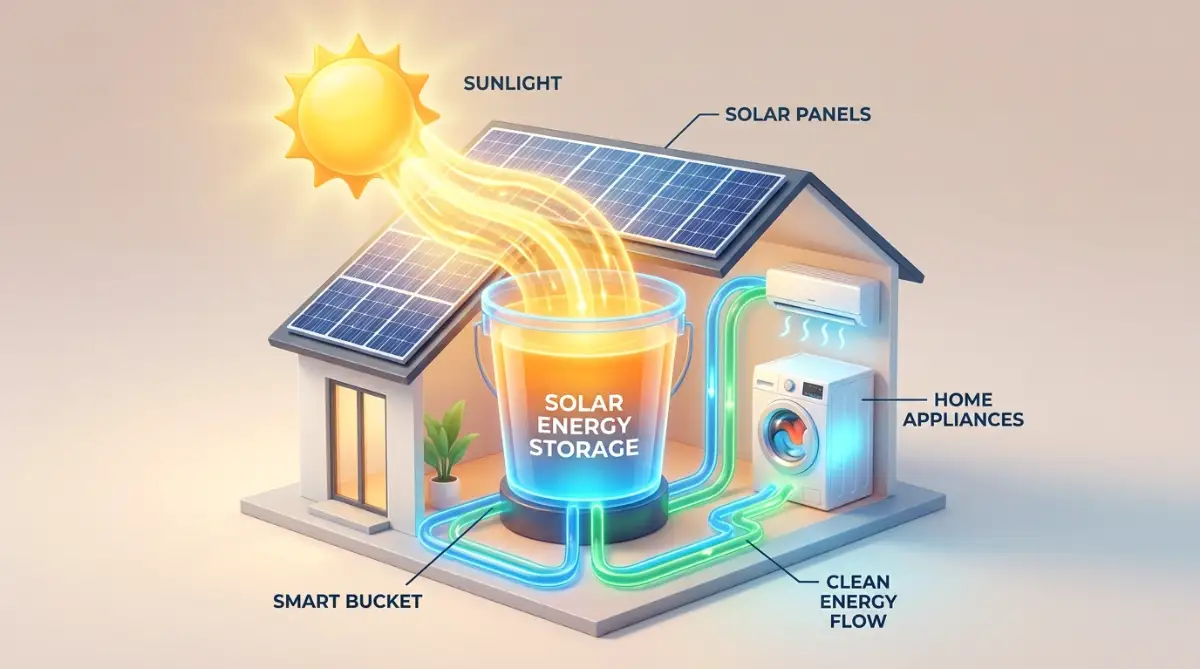
However, many people completely ignore this natural energy curve. They leave their most power-hungry devices sitting idle while the sun blares down outside. To maximize your savings, you have to become an active manager of your home's daily energy flow. You have to identify which machines draw the most power and intentionally schedule them for the middle of the day.
Identifying Your Biggest Energy Hogs
Not all home appliances are created equal when it comes to electricity consumption. Your television and laptop use barely any power compared to the real heavy hitters in your home. We need to focus our attention strictly on things that heat up, cool down, or spin rapidly. These are the machines that will drain your energy wallet if you run them at night.
The biggest culprits are usually your central air conditioning unit and your electric water heater. Next on the list are your laundry dryer, the washing machine, the dishwasher, and electric ovens. Even things like an electric vehicle charger or a backyard pool pump require a massive amount of power. If you can shift the run times of just these specific items, your grid dependence will drop drastically.
My Personal Appliance Priority List:
To make things super easy, here is how I rank my home appliances based on how badly they drain the grid. Focus on fixing the "High Priority" ones first:
- High Priority (Move to daytime immediately): Central AC, Electric Water Heater, Pool Pump.
- Medium Priority (Use Delay Start): Dishwasher, Washing Machine, Clothes Dryer.
- Low Priority (Don't worry about it): Laptops, TVs, LED light bulbs, Ceiling fans.
The Magic of the "Delay Start" Button
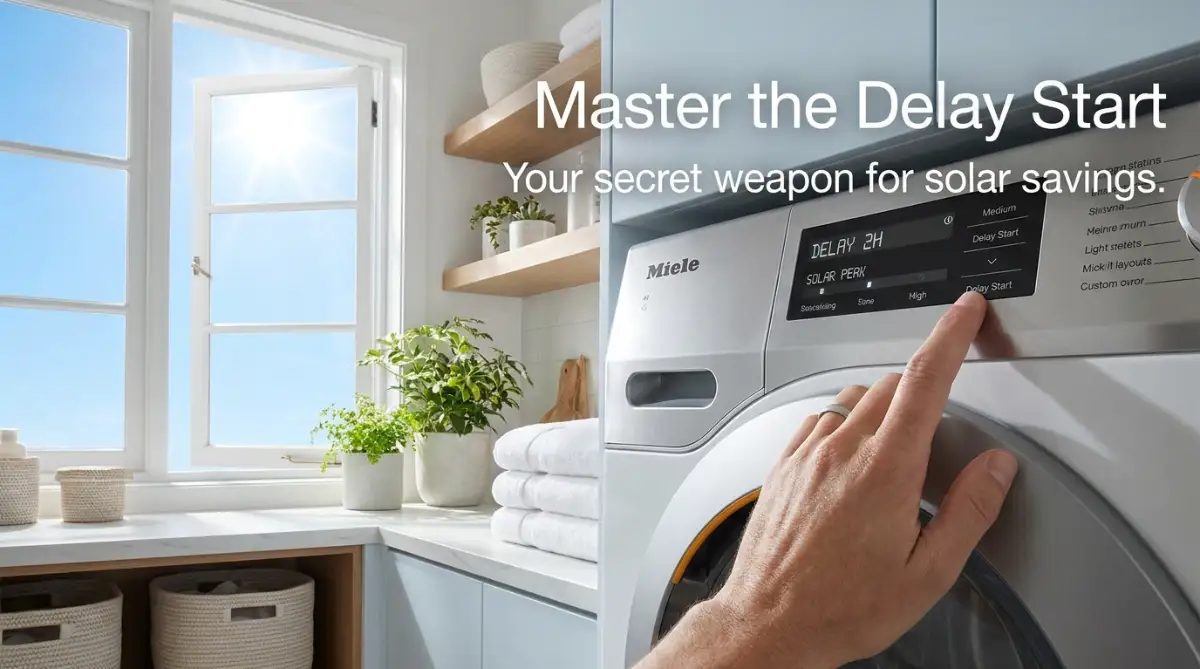
One of the greatest inventions on modern home appliances is the simple delay start feature. Almost every dishwasher and washing machine made recently has a button that lets you push back the start time. This tiny button is your absolute best friend when it comes to solar energy management. It allows you to load your machines at night or early in the morning before you leave for work.
Instead of turning the dishwasher on right after dinner, load it up and add your detergent. Then, set the delay timer for about 12 to 14 hours. The machine will sit quietly all night and suddenly turn on right around noon the next day. By the time you get home from work, your dishes are perfectly clean and dried using pure solar power.
I used to run my washing machine every single night right before going to bed out of pure habit. Once I started loading it in the morning and setting a 4-hour delay start, I instantly saw my grid usage drop on my tracking app. It is amazing how such a tiny shift in my routine saved me so much money without taking up any extra time in my day.
You can do the exact same thing with your laundry loads. Put your dirty clothes in the washing machine before you drink your morning coffee. Set the delay start so the cycle runs exactly when the sun is hitting your roof at its strongest angle. Your clothes will be sitting damp for a little while, but you will save a significant amount of money.
Watch this quick guide to understand exactly how delaying your appliance usage forces your solar panels to work for your wallet.
Pre-Cooling and Pre-Heating Your Home
Heating and cooling usually account for more than half of a standard household's total energy bill. It requires a tremendous amount of electricity to change the physical temperature of an entire house. Most people leave their AC turned off all day while they are at work to save money. Then, they come home at 5:00 PM, turn it on full blast, and pull massive amounts of grid power.
A much smarter strategy is a concept known as "pre-cooling" or "pre-heating." The idea is to use your free daytime solar energy to make your house extremely comfortable before the sun goes down. You essentially treat your entire house like a giant thermal battery that holds onto the temperature.
If it is a hot summer day, program your smart thermostat to drop the temperature around 1:00 PM. Let your air conditioner run hard while your solar panels are producing their absolute maximum output. Your house will get very chilly by the time late afternoon arrives. Once the sun starts to set and solar production drops, you can turn the AC completely off. The house will naturally stay cool for several hours into the evening, saving you from using expensive grid power.
Managing The Electric Water Heater
Your electric water heater is basically a giant kettle sitting in your garage or basement. It turns on and off constantly throughout the entire day and night to keep water hot. Every time it turns on at night, you are paying the utility company for that heating cycle. This is a massive waste of resources if you have solar panels on your roof.
To sync this heavy appliance, you need to restrict when it is allowed to draw power. You can easily install an inexpensive mechanical or smart timer directly on the water heater circuit. Set the timer so the heating element only receives electricity between 10:00 AM and 3:00 PM.
The water heater will absorb your peak solar power and heat the tank up to its maximum safe temperature. Because the tank is highly insulated, that water will stay piping hot all evening for your showers and dishwashing. You get all the comfort of hot water without paying a single dime to the utility company at night.
Quick Real-Life Math: Let’s say your water heater runs for 3 hours every night at 20 cents per kWh. That is roughly $2.70 a day, or over $80 a month just to keep water hot while you sleep! By simply installing a $20 heavy-duty mechanical timer to force the heater to run only at 1 PM, you completely wipe out that $80 monthly expense. It is literally the easiest return on investment you will ever get.
Myth vs Reality: Cloudy Days and Solar Usage
The Myth: People often think that if it is cloudy outside, their solar panels completely stop working. Because of this belief, they avoid running any heavy appliances on overcast days. They assume they will just pull everything from the grid anyway.
The Reality: Solar panels are actually incredibly efficient at gathering ambient light even through thick cloud cover. While your production will definitely be lower than on a bright sunny day, you are still generating significant free electricity. You should still run your heavy appliances during the middle of the day. Using whatever solar energy you are producing is always better than paying full price for grid power at midnight.
A Quick Breakdown of Appliance Timing
To make this super easy to understand, let's look at a simple breakdown. This chart shows the most power-hungry household items and the best possible time to run them.
By following a simple schedule like this, you take total control over your energy destiny. You stop being a passive consumer and become an active manager of your own micro-grid.
Utilizing Smart Plugs for Dumb Appliances
Not every machine in your house has a built-in delay timer or a smart computer inside. You might have a standalone deep freezer, a dehumidifier in the basement, or a standard window air conditioning unit. These older, "dumb" appliances will just run whenever they feel like it, pulling power constantly.
This is exactly where heavy-duty smart plugs come into the picture to save the day. You can plug your dehumidifier or window AC unit directly into a smart plug that connects to your Wi-Fi. Then, using an app on your phone, you easily create a custom daily schedule for that specific outlet.
You can program the smart plug to turn the power on strictly at 11:00 AM and shut it off entirely at 3:00 PM. Now, even your oldest machines are perfectly synced with your modern solar power system. It is a highly affordable trick that costs just a few dollars but saves hundreds over the lifespan of the panels.
Reading Your Inverter Data Like a Pro
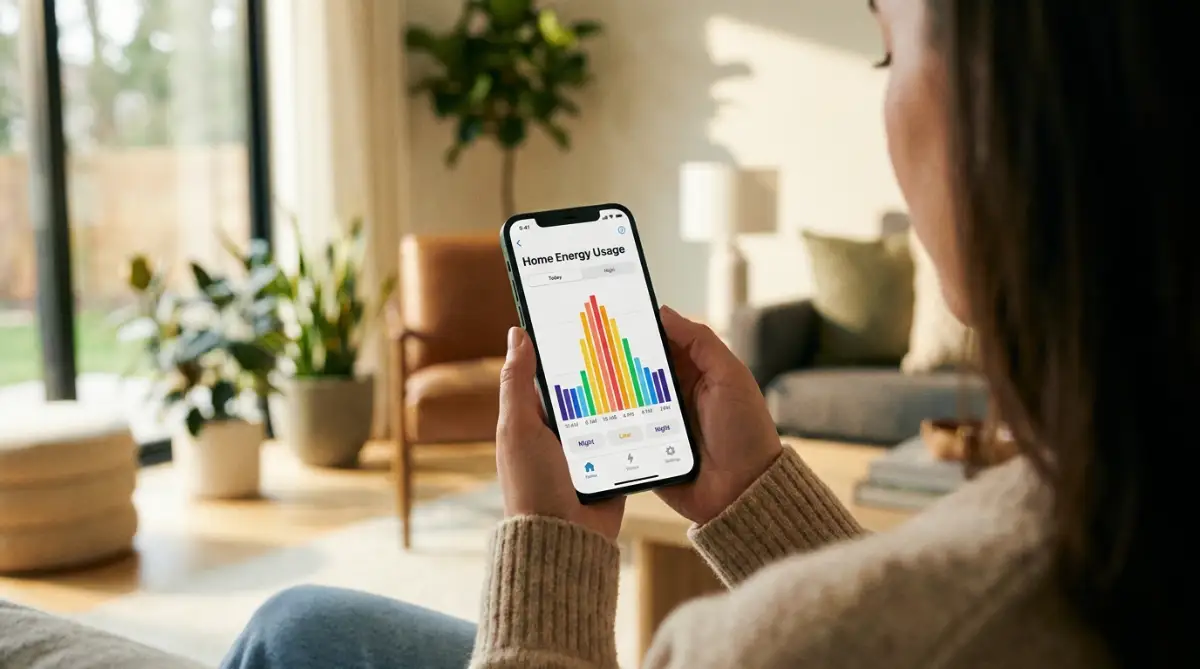
If you really want to maximize your solar investment, you need to look at your tracking app regularly. Most modern solar setups come with a dedicated smartphone app that shows your live production and consumption. Checking this app should become a daily habit, just like checking the local weather forecast.
When you open the app, you will usually see a bell-shaped curve representing your daily solar generation. You want to visually match your home's energy consumption line to fit perfectly inside that bell curve. If you see massive consumption spikes happening outside of that curve, you know you have a habit problem to fix.
Take a few minutes every Sunday evening to review last week's data graphs. You might notice that someone in the house always takes a long shower at 8 PM, triggering the water heater. Once you spot these patterns in the data, you can have a friendly family conversation about adjusting routines. Small adjustments based on real data will dramatically shrink your reliance on the expensive grid.
Next-Level Solar Mastery: Automating Your Daily Success
Once you get comfortable with the basic delay start buttons, you can take your savings strategy even further. True energy independence happens when you start thinking about the overall capacity of your system. You have to treat your rooftop panels like a personal power plant that has a strict speed limit.
One of my biggest breakthroughs was understanding the concept of "appliance staggering." When I first started trying to use my solar power during the day, I made a massive error. I would program my washing machine, my dryer, and my dishwasher to all start exactly at noon. I thought I was being incredibly smart by moving everything to the middle of the day.
What I did not realize was that I was completely overloading my solar production limit. If your system produces 5 kilowatts of power, but you turn on 8 kilowatts worth of machines simultaneously, you are in trouble. The solar panels will cover the first 5 kilowatts, but your house will automatically pull the remaining 3 kilowatts from the utility grid. You end up paying peak grid prices right in the middle of a beautiful sunny day.
The Art of Sequencing Your Power Draw
To fix this, you have to sequence your heavy machines like a carefully choreographed dance. Instead of running everything at noon, you spread them out across your entire peak production window. You want to keep your home's total power draw just below your solar production line at all times.
For example, you can schedule your washing machine to run at 10:30 AM when the sun is getting strong. By the time that cycle finishes around 11:30 AM, your system is ready for the next task. Then, you can safely move those wet clothes into the electric dryer right at noon. Because the washing machine is already off, the dryer gets to use 100% of the available solar energy.
You can follow this up by having your dishwasher turn on at 2:00 PM. This method ensures you never accidentally spike your energy usage above what your roof can provide. If you want to dive deeper into optimizing your home energy setup, you will find that pacing is everything. It is exactly like driving on a highway; keeping a steady speed gets you better mileage than constantly flooring the gas pedal.
Getting Smart with Home Energy Monitors
If you are serious about slashing your electric bill, you need to see exactly what is happening in real-time. The basic app that comes with your solar inverter is good, but it often lacks fine details. I highly recommend investing in a dedicated home energy monitor that connects directly to your electrical panel.
Devices like the Sense monitor or Emporia system clip onto your main power lines and read the data instantly. They use advanced machine learning to identify the specific electrical signature of every machine in your house. You can sit on your couch, open the app on your phone, and see exactly how much power your refrigerator is using right now.
This level of visibility completely changes how you interact with your house. You stop guessing and start making confident decisions based on hard data. According to research on residential energy management by the National Renewable Energy Laboratory, homeowners who actively monitor their real-time usage see significantly faster returns on their solar investments. You will quickly spot which appliances are quietly stealing your hard-earned power.
Adapting to Seasonal Sun Angles
Another advanced secret is learning how to adjust your habits based on the changing seasons. The sun does not travel across the sky in the exact same path every single month. During the long days of summer, your peak production window might stretch from 9:00 AM all the way to 4:00 PM.
This gives you a massive, forgiving window to run almost every machine you own. But when winter arrives, the sun sits much lower on the horizon and the days get shorter. Your peak production window might shrink down to just 11:00 AM until 2:00 PM.
You must adapt your appliance scheduling to match this tighter winter window. You might have to skip a day of laundry or wait for a brighter afternoon to run the pool pump. Being mindful of these seasonal shifts ensures you are never caught off guard by a sudden spike in your winter utility bills.
Silent Energy Killers That Wipe Out Your Savings
Even with the best intentions, it is incredibly easy to fall into hidden traps that drain your wallet. I have seen so many homeowners get frustrated because they think they are doing everything right, but their bills stay high. Most of the time, this frustration comes from making a few very common, yet entirely avoidable mistakes.
The biggest pitfall is ignoring the quiet machines that run continuously in the background. We spend so much time worrying about the air conditioner that we completely forget about the old freezer in the garage. That ancient freezer might be turning its compressor on every twenty minutes, day and night, regardless of the sun.
These constant background drains are known as "vampire loads" or phantom power. Over an entire month, an inefficient secondary fridge can consume more electricity than your massive oven. You are paying the utility company a premium rate every single night just to keep a few extra frozen pizzas cold.
The Danger of Factory Default Settings
Another massive mistake is blindly trusting the factory default settings on your smart appliances. When you buy a brand new smart thermostat, it usually comes pre-programmed with a generic schedule. This schedule is designed for a typical family that works 9 to 5, not for someone trying to maximize solar power.
The default setting will usually try to cool the house aggressively right when you get home at 5:30 PM. This is the exact moment your solar panels are powering down for the evening. If you leave these default settings active, your smart thermostat is actually working against your financial goals. You have to manually delete the factory schedule and build a custom one that aggressively pre-cools the house at 1:00 PM instead.
According to guidelines from Energy Star, a properly customized smart thermostat is one of the most effective tools for reducing grid dependence. You must be the one in control of the programming, not the appliance manufacturer.
Over-Relying on Small Battery Systems
If you were lucky enough to install a hybrid system with a small backup battery, you need to be extra careful. Many people think having a small battery means they can just run whatever they want at night. They turn on the oven and the electric dryer at 8:00 PM, assuming the battery will easily handle the load.
A standard home battery is usually designed to keep your lights on and your fridge cold during a power outage. It is not built to push massive amounts of power to an electric heating element for hours on end. If you drain your battery completely dry every single evening just doing laundry, you are degrading its lifespan.
Constantly draining a storage system to zero can cause permanent chemical damage over time. If you want to know more about protecting your solar battery capacity, you must understand the limits of its daily cycle. You still need to shift your heavy loads to the daytime, leaving the battery full to smoothly run your television and lights at night.
Failing to Communicate with the Family
The most heartbreaking mistake I see is a lack of communication within the household. One person becomes obsessed with tracking the solar app and optimizing the energy flow. Meanwhile, the teenagers in the house are taking hour-long hot showers at midnight and leaving gaming computers running 24/7.
You cannot manage a home's energy profile entirely on your own. It requires a team effort and a shared understanding of how the system actually works. If you just yell at your family to turn the lights off, they will get annoyed and ignore you.
Instead, sit down and explain how the system actually saves the family money. Show them the app on a sunny day and point out how the house is running on pure sunshine. When everyone understands the "why" behind the new schedules, they are much more likely to cooperate without complaining.
Ignoring Regular Panel Maintenance
You can have the most perfect appliance schedule in the world, but it will fail if your panels are filthy. I once spent an entire month frustrated because my system was underperforming by almost 20 percent. I checked all my settings, reviewed my smart plugs, and could not find the problem.
Finally, I grabbed a ladder and looked at my roof. My beautiful solar panels were covered in a thick layer of spring pollen and bird droppings. This physical barrier was blocking the sunlight from reaching the photovoltaic cells, completely ruining my peak production curve.
You have to treat your solar array like the windshield of your car. If it gets covered in dust, ash, or leaves, it simply cannot do its job properly. Rinsing your panels a few times a year ensures you are actually generating the power you need to run your appliances. Furthermore, always make sure you are prioritizing indoor solar battery safety if your setup includes heavy storage equipment in the garage.
Your Roadmap to Financial Freedom from the Grid
Shifting your household habits to match the sun might feel a little strange at first. We are all so deeply conditioned to treat electricity as an endless, invisible resource that we can use anytime. But taking active control of your power consumption is one of the most rewarding changes you can make.
Every time you press that delay start button, you are keeping money in your own bank account. You are telling the utility company that you no longer need their expensive evening power. It becomes an incredibly fun and satisfying game to see how low you can push your monthly statement.
Start small by picking just one heavy appliance, like the dishwasher, and moving its run time to noon. Watch how that single, simple change positively affects your energy graph on the app. Once you see the immediate financial benefit, you will naturally want to start optimizing the rest of your house.
I honestly used to dread opening my electric bill every month, even after getting panels. But once I finally synced my family's habits with our roof's production, everything changed completely. My bill dropped to the bare minimum connection fee, and I finally felt the absolute freedom I was promised.
Real Questions Homeowners Ask About Solar Timing
Do I really need to run my AC during the day if no one is home?
Yes, pre-cooling your house during peak solar hours is highly effective. By chilling the house with free daytime energy, the structure holds the cold air into the evening. This prevents your AC from pulling expensive grid power when you return home at 5 PM.
Can I run my pool pump at night since electricity rates are sometimes lower?
Even if nighttime grid rates are slightly lower, solar power during the day is 100% free. You should always program your heavy pool pump to run exclusively during your peak sunlight hours. This ensures you are never paying the utility company for pool maintenance.
What if I work in an office and cannot load the washing machine during the day?
This is exactly why you should rely heavily on the delay start feature. You simply load your clothes in the morning before leaving for the office and set a 4-hour delay. The machine will automatically run off solar power while you are sitting at your desk at work.
Will running all my appliances at once damage my solar inverter?
It will not damage the inverter, but it will definitely hurt your wallet. If you exceed your solar system's maximum output, the extra required power is automatically drawn from the utility grid. You should stagger your heavy appliances throughout the day to stay strictly within your free energy limit.
Do smart plugs really help save money with solar power?
Absolutely, smart plugs are a game-changer for older machines that do not have built-in timers. They allow you to force "dumb" appliances, like a basement dehumidifier, to only run when the sun is shining. It is a very cheap upgrade that prevents power drain during the night.
Disclaimer: The information provided in this article is for educational and informational purposes only. Every home electrical setup and solar installation is unique. Always consult with a licensed electrician or your solar provider before making any permanent modifications to your electrical panels, heavy appliances, or home energy storage systems.