The Sweaty, Sleepless Nights: My Battle With an Overheated House
You know that heavy, suffocating wall of heat that hits you the second you walk upstairs on a summer afternoon? Yeah, I lived with that nightmare for years. I used to think my AC was just getting old, but the real villain was actually hiding right above my bedroom ceiling. Today, I am going to show you exactly how I fixed it without spending a fortune.
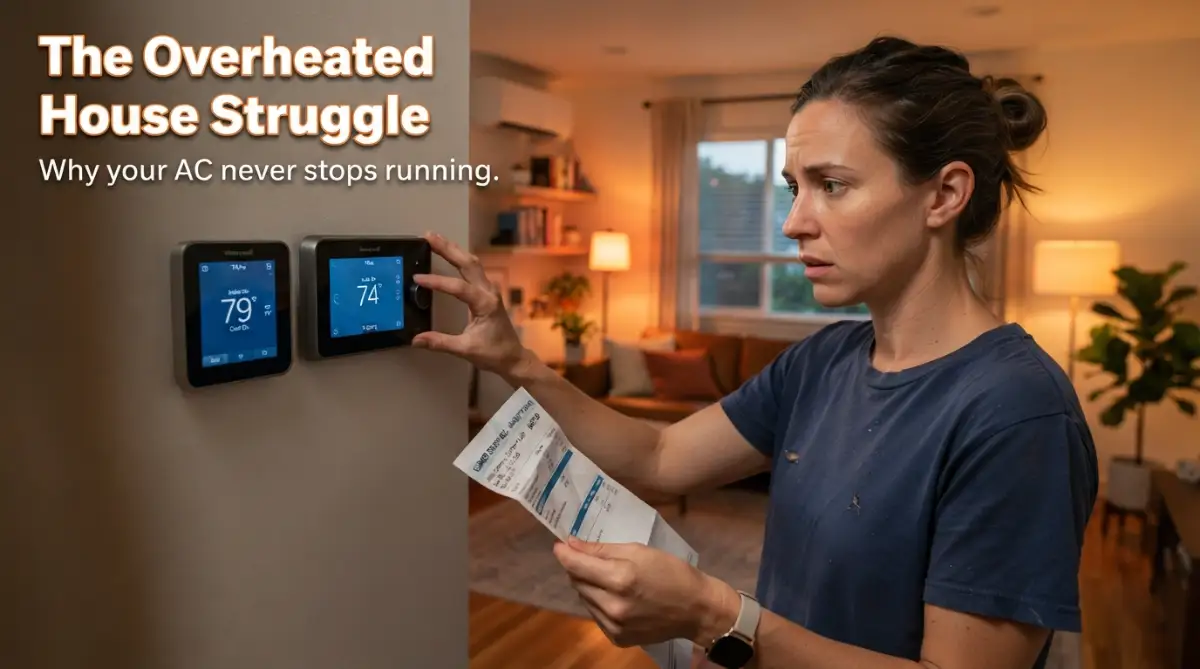
The worst part is the feeling of helplessness. You pay a small fortune for an air conditioning system, and it still fails to keep your living spaces comfortable. The constant background noise of the AC running without a break becomes a stressful reminder of the money flowing out of your bank account.
You start wondering if your insulation is bad, if your windows are leaking, or if your cooling system is completely broken. I spent weeks trying to block out the sun with thick curtains and running portable fans in every single room. Nothing seemed to make a real difference.
What You Will Learn in This Guide:
- Why trapped attic heat is secretly ruining your summer power bills.
- How a simple solar-powered fan forces 150-degree air out of your house.
- The easy "Flashlight Test" to make sure your roof can actually breathe.
- Why ignoring your intake vents will accidentally suck the AC right out of your living room.
Understanding the Giant Oven Above Your Ceiling
To fix this exhausting problem, we have to look at the space directly above our heads. Most homeowners rarely think about their attic unless they are storing old holiday decorations. However, that dark, empty space is actually the primary reason your house feels impossibly hot.
When the sun beats down on your roof, the shingles absorb a massive amount of solar radiation. This heat easily transfers right through the wood and into your attic space. Because heat naturally rises, the hot air gets completely trapped up there with nowhere to escape.
On a standard sunny afternoon, the temperature inside a poorly ventilated attic can easily reach an astonishing 150 degrees Fahrenheit. Just think about that for a second. You basically have a massive, blazing oven sitting right on top of your bedroom ceiling.
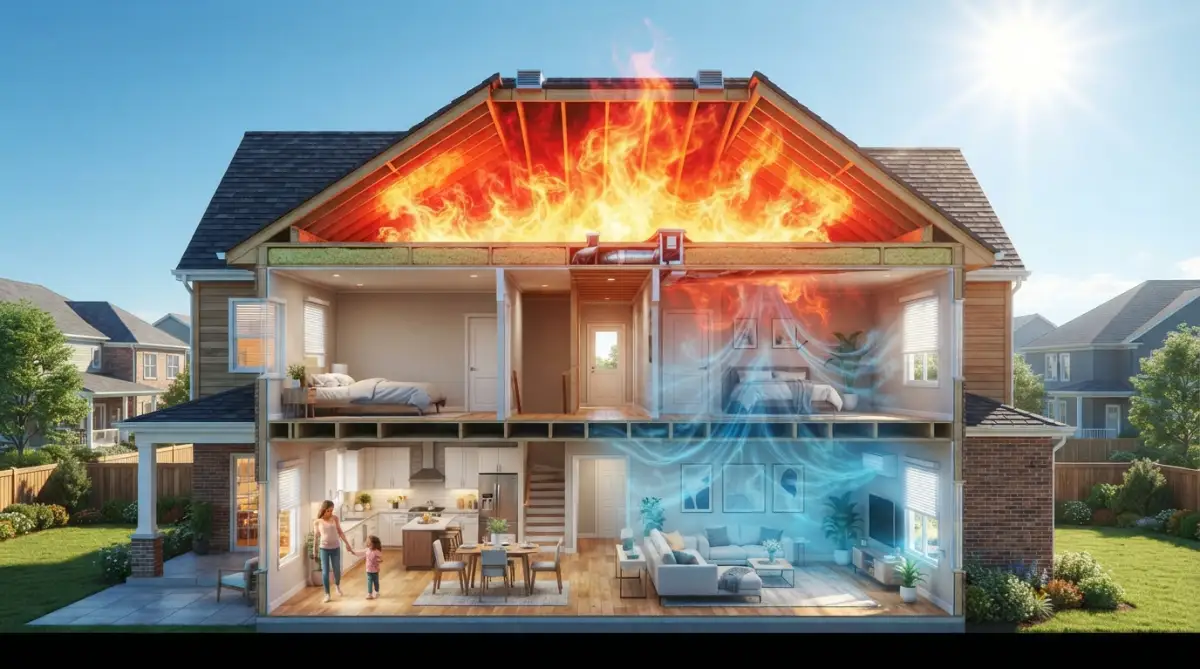
This trapped heat does not just stay in the attic. The basic laws of physics dictate that heat will always move toward cooler spaces. The extreme heat pushes down through your ceiling, warming up your insulation, your drywall, and eventually the air inside your living space.
The Physics of Heat Transfer in Simple Terms
You do not need to be a scientist to understand why your air conditioner is struggling so much. It all comes down to a process called thermal radiation. When the attic floor gets incredibly hot, it radiates that heat directly into the rooms below.
Imagine baking a pizza in your kitchen and leaving the hot oven door wide open. You could turn on a desk fan, but the kitchen would still get unbearably hot. Your air conditioner is fighting a losing battle because the heat source never turns off.
This is exactly why your AC keeps turning on every ten minutes. The thermostat registers the cool air, shuts off the system, and then the radiating ceiling heat immediately warms the room back up. It is a completely vicious cycle that ruins your equipment and drains your wallet.
To solve this, you have to stop treating the symptom (the hot rooms) and start treating the root cause (the boiling attic). You need a way to actively pull that trapped, heavy heat out of the house. This is exactly where modern ventilation technology steps into the picture.
Quick Comparison: Passive Vents vs. Active Solar Fans
| Feature | Regular Passive Vents | Solar Attic Fan |
| :--- | :--- | :--- |
| How it works | Relies on wind and natural airflow | Uses a motor to force hot air out |
| Hot windless days | Basically useless | Works at full speed using sun power |
| Cooling speed | Very slow | Drops temps in a matter of hours |
| Running cost | $0 | $0 (Powered entirely by the sun) |
How Active Solar Ventilation Changes the Game
Traditional houses usually have passive vents, like those small grates you see under the roof eaves. Passive vents rely entirely on the wind and natural temperature differences to move air around. Unfortunately, on a still, sweltering summer day, passive ventilation does absolutely nothing.
This is why active ventilation is a total game changer. An active system physically forces the hot air out and aggressively pulls fresh, cooler air in. Instead of waiting for a breeze, an active exhaust fan takes complete control of your attic's climate.
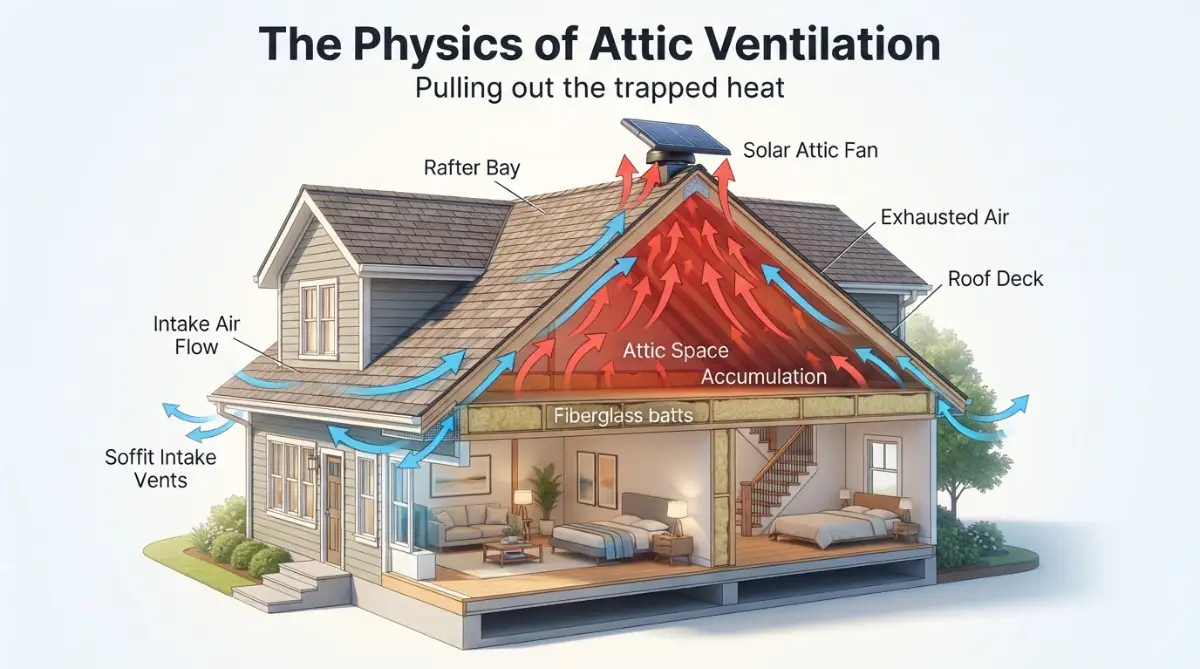
A solar-powered attic fan is essentially a heavy-duty exhaust system mounted directly onto your roof. It features a built-in solar panel that captures sunlight to power a strong motor. As soon as the sun hits the panel, the fan blades start spinning rapidly.
"If you are a visual learner, watch this incredible breakdown of how attic airflow directly impacts your indoor temperature and cooling expenses."
The beauty of this system is how completely automatic it is. The hotter the sun shines, the faster the fan spins. It actively sucks the 150-degree air out of the attic and exhausts it straight into the sky.
As that boiling air is forced out, it creates a negative pressure zone inside the attic space. This vacuum effect automatically pulls cooler, shaded air in from the outside vents located under your roof line. You are essentially creating a powerful, constant river of air flowing through your roof.
Breaking Down the Direct Impact on Cooling Costs
So, how does a spinning fan on the roof actually save you money? The math is wonderfully simple once you understand the airflow. By constantly flushing out the hot air, the solar fan drops your overall attic temperature by up to 40 or 50 degrees.
When your attic drops from 150 degrees down to 100 degrees, the heavy heat stops pressing down onto your living spaces. Your ceiling remains cool to the touch. Your bedrooms stop feeling like saunas.
Because the heat intrusion stops, your air conditioner suddenly gets a massive break. The thermostat finally reads a steady, cool temperature and tells the AC unit to shut down and rest.
I used to think leaving my attic access hatch slightly open in the summer would help the hot air escape. I quickly realized this just sucked the expensive, air-conditioned air right out of my hallway and into the dusty roof! Keeping the house totally sealed while the solar fan does the heavy lifting outside is the real secret.
Fewer cooling cycles mean your compressor uses significantly less electricity. Depending on your home size and local climate, you can see a noticeable drop in your monthly energy bills. Homeowners often report their cooling costs dropping by a very healthy margin once the solar fan is installed.
Let’s do some quick math on the payback time:
If you spend around $300 on a quality solar fan, and it saves you just $40 a month on your summer electric bills (say, 5 months out of the year), you get $200 back in your pocket the very first year. By the middle of year two, the fan has completely paid for itself. After that? It is 100% free cooling.
Giving Your HVAC System a Much Longer Life
There is another hidden financial benefit that most people completely ignore. Your air conditioning system is easily one of the most expensive appliances in your entire home. Replacing a burned-out AC unit can cost thousands of dollars.
When your attic is unventilated, your AC compressor runs almost constantly to fight the radiant heat. This continuous operation causes massive wear and tear on the motors, belts, and electrical components. The equipment ages incredibly fast under that kind of stress.
By installing a solar attic fan, you are drastically reducing the workload on your HVAC system. Because the cooling cycles become much shorter and less frequent, the physical parts of your AC unit experience far less friction and heat degradation.
You are effectively adding years to the lifespan of your cooling equipment. The money you save by delaying a massive AC replacement is often way higher than the small savings on your monthly power bill. It is a protective measure for your biggest home investment.
Myth vs Reality: The Truth About Solar Vents
When I started looking into roof ventilation, I found a lot of confusing information online. Let us clear up some of the most common misunderstandings about this technology.
Myth: Solar fans are too expensive and never pay for themselves.
Reality: The initial cost is actually quite reasonable compared to replacing an AC unit. Because they use zero grid electricity to run, every bit of cooling they provide is totally free. The return on investment happens steadily over time through lower bills and protected equipment.
Myth: They make too much noise and will ruin the peace of the house.
Reality: Modern solar fans use highly balanced, brushless motors. They are installed on the exterior of the roof, above heavy insulation. You will rarely, if ever, hear them running from inside your bedroom.
Myth: They only work well in extremely hot, tropical climates.
Reality: Any place that gets direct sunlight will experience massive attic heat gain. Even in moderate climates, a sunny day will easily cook a poorly ventilated roof space.
The Unseen Bonus: Moisture and Mold Protection
While we are highly focused on keeping the house cool, these solar units offer another incredible scientific benefit. They act as a powerful defense system against hidden home damage.
Daily activities like taking hot showers, boiling pasta, and even breathing release gallons of water vapor into your home. This warm, humid air naturally rises and eventually sneaks up into your attic.
If this moisture gets trapped in a dark, stagnant attic, it starts to condense on the wooden rafters. Over time, this dampness creates the perfect breeding ground for toxic black mold and wood rot. You could be facing severe structural damage without ever knowing it.
A solar attic fan solves this issue effortlessly. Because it is constantly exchanging the air, it blows all that trapped humidity right out of the house. It keeps your wooden roof deck perfectly dry and structurally sound.
Even in cooler months, when the sun is out, the fan keeps fresh air moving. It prevents winter ice dams from forming on your roof edges by keeping the roof temperature consistent. It is truly a year-round protector for your entire home.
Pro-Level Secrets for Getting the Coldest House Possible
You might think that buying a fan, tossing it on the roof, and waiting for the sun to shine is the end of the story. I certainly thought that when I first started exploring this upgrade. However, there is a massive difference between a fan that just spins and a fan that completely transforms your living space.
To actually see those huge drops in your monthly cooling bills, the system needs to breathe correctly. Think of your attic like a giant set of lungs. If you try to breathe out forcefully without ever taking a breath in, you are going to pass out.
Your solar exhaust fan is doing the breathing out. It is aggressively pushing the trapped, boiling air into the sky. But where is the replacement air coming from?
This brings us to the most essential secret of attic ventilation. You absolutely must have clear, unblocked intake vents. These are usually located under the eaves of your roof, known as soffit vents.
When the fan creates a vacuum, it reaches down to those soffit vents and pulls in cooler, shaded air from outside. This constant sweeping motion of fresh air is what actually cools the physical structure of your house.
The Flashlight Test for Better Airflow
A lot of people complain that their new roof fan is not dropping their indoor temperatures. Nine times out of ten, their intake vents are completely suffocated. Over time, blowing dust, old bird nests, or thick fiberglass insulation can easily plug up these airways.
You can do a super easy check this weekend. Grab a strong flashlight and pop your head up into the attic hatch during the day. Turn the flashlight off and look toward the edges of your roof.
You should see clear daylight peeking through the edges. If it is completely pitch black where the roof meets the floor, your soffit vents are blocked. Clearing these out will instantly supercharge your fan's performance.
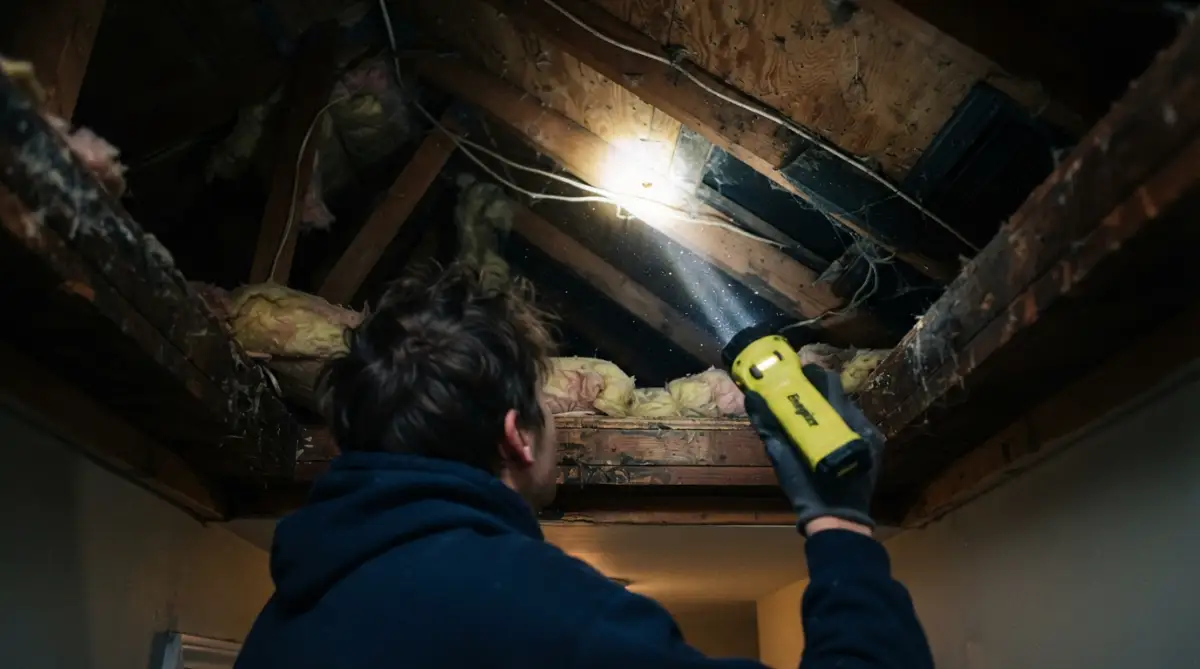
This simple maintenance task is just like keeping solar systems running efficiently in other areas of your home. A system can only perform well if its basic pathways are clear and clean.
Sizing It Right: The CFM Golden Rule
Another massive secret is understanding how much power you actually need. Roof fans are rated by something called CFM, which stands for Cubic Feet per Minute. This number simply tells you how much air the motor can move in sixty seconds.
If you have a massive, sprawling ranch-style home, a tiny solar fan from the local hardware store will barely make a dent in the heat. It is like trying to empty a swimming pool with a drinking straw.
A good rule of thumb is that you need about 10 CFM for every 10 square feet of attic space. So, if your attic is 1,500 square feet, you want a fan that pushes at least 1,500 CFM.
Do not be afraid to install two smaller fans instead of one massive unit if you have a complicated roof shape. Spreading the exhaust points out can actually create a much smoother airflow across the entire length of the house.
Smart Sensors and Weather Adaptation
The newest solar tech on the market has gotten surprisingly smart. You do not just have to rely on a dumb motor that spins whenever the sun is out. Modern units often come with built-in thermal switches and humidistats.
A thermal switch tells the fan to stay off until the attic actually reaches a specific temperature, usually around 80 degrees. This saves wear and tear on the motor bearings during cooler spring mornings when you do not actually need the ventilation.
The humidistat is even more impressive. It detects when the air gets thick and sticky with moisture. Even on a cloudy day, if the humidity reaches a dangerous level, the fan will kick on to protect your wooden rafters from mold.
Understanding these small technical details comes directly from trusted national renewable energy laboratory research. Science shows us that smart, responsive ventilation is always better than a system running completely blind.
The Hidden Traps That Will Ruin Your Cooling Strategy
Even with the best intentions, I see homeowners making disastrous mistakes when trying to cool their attics. These errors do not just stop the fan from working. Sometimes, they actually drive your air conditioning bill even higher.
Let me share a very real scenario that happens all the time. Imagine a homeowner installing a powerful solar fan but having completely blocked intake vents. The fan turns on, spinning wildly, desperate to pull air from somewhere.
Because it cannot pull air from the outside soffits, it starts pulling air from the path of least resistance. That path is usually right through the recessed lighting fixtures, bathroom exhaust fans, and tiny cracks in the ceiling.
Sucking the AC Right Out the Roof
This is an absolute nightmare scenario. Your brand new roof fan is literally sucking your expensive, air-conditioned air out of your living room and blowing it into the sky. You are paying your utility company to cool the neighborhood birds.
You will notice your air conditioner running constantly, yet the house feels hot and stuffy. This is called negative pressure intrusion. It completely defeats the entire purpose of having an insulated ceiling.
To stop this from happening, you have to seal your ceiling completely. Use expanding foam around any pipes or wires that go up into the attic space. Make sure your attic hatch has a thick weather stripping seal around the edges.
The "Short Circuit" Airflow Mistake
Another massive mistake is mixing different types of exhaust vents on the exact same roof. Many older houses have ridge vents, which are passive slits running along the very top peak of the roof.
If you install an active solar fan right next to a passive ridge vent, you create a major airflow short circuit. The strong fan will simply pull air straight from the nearby ridge vent and blow it right back out.
The fresh air basically does a tiny U-turn at the top of the roof. Meanwhile, the heavy, boiling air sitting down at the bottom of the attic stays completely untouched.
If you are going to use an active solar fan, you need to seal up those nearby passive roof vents. You want the fan forced to pull air all the way from the bottom edges of the roof, sweeping the entire space clean.
Before making major modifications to your roof structure, it is always smart to think about structural integrity. When you are evaluating roof safety for solar additions, making sure you aren't compromising your shingles is a major priority.
Ignoring the Insulation Layer
Finally, do not let a fancy new fan trick you into ignoring your basic insulation. The fan removes the hot air, but the insulation is what physically separates your living room from the attic space.
If you only have two inches of flattened, dusty fiberglass up there, even a perfectly ventilated attic will still leak heat into your house. The two systems have to work together as a team.
Think of the insulation as a heavy winter coat, and the fan as a cold breeze. You need both to survive the extreme temperatures up there. Taking the time to blow in some extra cellulose insulation while you are installing the fan will double your energy savings.
Following basic government energy efficiency guidelines always recommends tackling ventilation and insulation at the exact same time for the best financial return.
Your Action Plan for a Cooler, Cheaper Summer
We have covered a lot of ground today, but the path forward is actually incredibly straightforward. You no longer have to feel like a victim to your summer energy bills or your struggling air conditioner.
You now understand exactly how the giant oven above your ceiling is fighting against your thermostat. By utilizing the free power of the sun, you can turn that stagnant, boiling trap into a cool, flowing river of fresh air.
Start by taking a quick look at your roof this week. Notice where your current vents are and think about how old your house is. If you hear your AC running for hours without stopping, you already know the heat is trapped up there.
There are plenty of incredible home improvement strategies out there, but few offer the immediate, noticeable relief of proper roof ventilation. It is a one-time upgrade that quietly pays you back every single time the sun comes up.
If you live way out in the country, maybe planning an off-grid solar setup, this technology is even more important. Protecting your limited battery power means doing everything possible to reduce your cooling loads naturally.
Taking control of your home’s comfort is an amazing feeling. I finally stopped dreading my July power bills, and my upstairs bedrooms are actually comfortable to sleep in again. Make the choice to fix the root cause today, and I promise you will never want to go back to a stagnant, overheated house.
Clear Answers to Your Biggest Attic Fan Questions
Do solar attic fans still work at night when it is dark?
Standard solar units do not run at night because they rely entirely on direct sunlight. However, once the sun goes down, your attic has already been purged of the extreme daytime heat. The natural nighttime air is usually cool enough that passive ventilation can handle the rest.
Will installing this void my existing roof warranty?
Most major roofing manufacturers fully support proper ventilation because it actually protects the shingles from baking from the inside out. As long as the fan is installed correctly using proper flashing and roofing sealant, your warranty will remain completely intact.
What happens if it rains heavily or snows?
These fans are specifically engineered with heavy-duty weather hoods and specialized flashing to completely block water intrusion. The top dome overlaps the actual vent opening by several inches, meaning even sideways blowing rain cannot get inside your roof.
Can I install one myself, or do I need a professional?
If you are comfortable safely climbing a ladder and know how to use a basic reciprocating saw, it is a very doable weekend DIY project. Because there is absolutely no electrical wiring required, you completely avoid the danger and expense of hiring a licensed electrician.
How long do the solar panels on these units typically last?
The small solar panels used on roof fans are incredibly durable and covered in tempered glass to resist hail and storm damage. You can easily expect the panel itself to effectively produce power for a good twenty years, though the internal motor might need swapping out after a decade.
Disclaimer: The information provided in this article is for educational and informational purposes only. Every home has unique structural and environmental factors. Always consult with a certified roofing professional or HVAC specialist before making significant modifications to your home’s ventilation system.