
When Exhaustion Becomes Your Normal
You hit the snooze button for the third time, but honestly, you feel like you could sleep for another year. Your morning coffee does not wake you up anymore; it just makes your heart race faster while your brain stays completely foggy. If your daily baseline feels like you are wading through thick mud, your body is trying to tell you something important—and you need to listen before it forces you to stop.
Does this sound a bit too familiar to you? You wake up feeling like you ran a marathon in your sleep. You go through your day feeling constantly on edge, like you are waiting for bad news to arrive at any moment.
We have completely normalized waking up exhausted. Millions of people walk around every single day with a nervous system that is trapped in high gear. You grab another cup of coffee, push through the brain fog, and completely ignore the random stomach aches.
The saddest part is how this hidden pressure slowly steals your everyday joy. You stop laughing at jokes, you lose your patience with the people you love most, and your mind never truly rests. Your mental peace is quietly drained away, leaving behind a version of you that feels hollow and disconnected.
We often think of burnout as a loud, dramatic breakdown. But the truth is entirely different. It is actually a quiet accumulation of ignored warnings. Your body is incredibly smart, and it never stops talking to you.
When you ignore the whispers, your body has no choice but to start shouting. That unexplained back pain, the sudden skin breakouts, and the random moments of dizziness are not just random bad luck. They are clear, desperate messages.
Fast Track Your Recovery: What You Need to Know
- Your mysterious stomach aches and stiff neck are not random bad luck; they are actual physical alarms.
- Resting does not just mean sleeping for eight hours; it means actively signaling safety to your nervous system.
- Small daily habits, like getting morning sunlight and setting strict boundaries, work far better than extreme weekend detoxes.
Decoding the Hidden Language of Your Nervous System
The Unbearable Weight on Your Shoulders
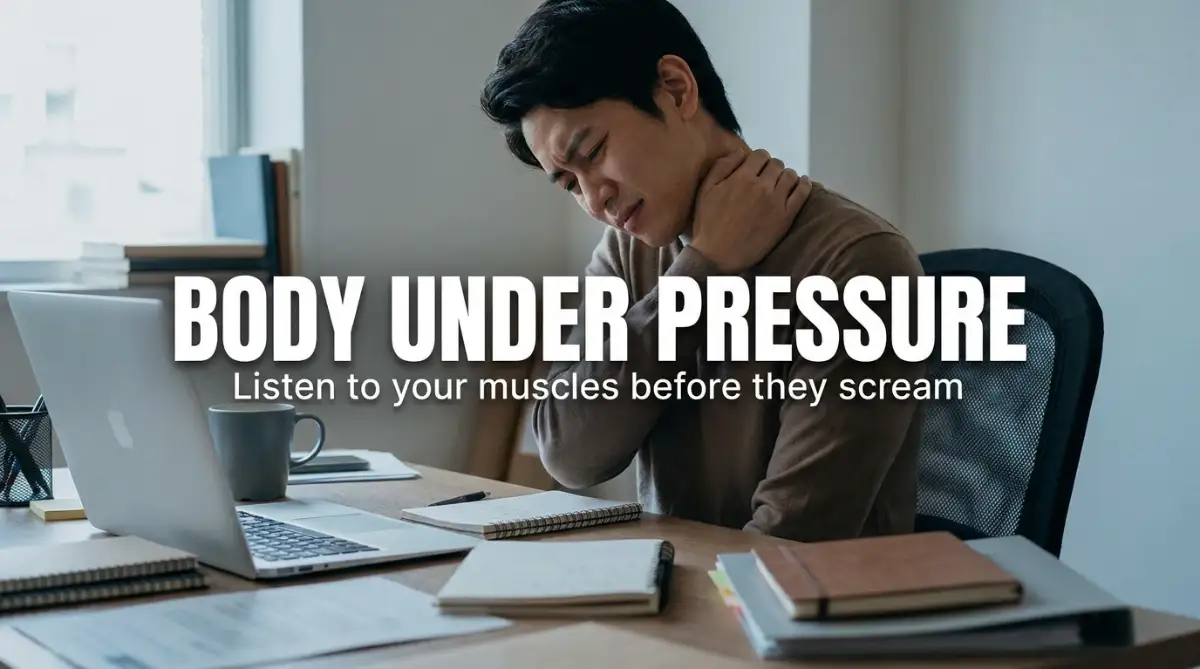
Have you ever noticed how your shoulders slowly creep up toward your ears when you are working? This is not just bad posture. It is a direct physical reaction to emotional pressure.
When your brain senses danger, even if that danger is just an unread email, it prepares your muscles to fight or run away. Because you cannot literally fight your inbox, that energy stays trapped in your muscles. Over time, this leads to chronic tension, tension headaches, and severe neck stiffness.

The Mysterious Stomach Issues
Your gut is often called your second brain, and it is incredibly sensitive to your emotions. When you are constantly worried, blood flow is actually pulled away from your digestive system. Your body thinks, "We do not need to digest food right now, we need to survive!"
This causes a chain reaction of uncomfortable problems. You might experience unexplained bloating, random cramps, or sudden changes in your bathroom habits. Many people spend a fortune on special diets, completely missing the fact that their gut is simply reacting to unresolved anxiety.
Pro Tip from My Own Experience: I spent months buying expensive probiotics and cutting out dairy, thinking I had developed sudden food allergies. My stomach issues only disappeared when I started taking 10-minute quiet breaks away from my phone during lunch. I realized my digestion was broken because I was always eating while in a state of high panic.
The Strange Case of Being Wired but Tired
This is perhaps the most frustrating sign of all. You feel totally wiped out all day long. But the second your head hits the pillow, your brain suddenly turns into a bright searchlight.
Your heart races, and you start thinking about an embarrassing thing you said five years ago. This happens because your cortisol levels are completely upside down. Instead of dropping at night to let you rest, your stress hormones spike, keeping you awake and alert.
Quick Check: Are You Running on Empty?
- The 3 PM Crash: You feel dizzy, shaky, or slightly nauseous right around mid-afternoon.
- The Memory Blip: You walk into a room and instantly forget why you are there at least twice a day.
- The Weekend Illusion: You think sleeping in on Saturday will fix everything, but the Sunday night panic still hits you hard.
- If you checked even one of these boxes, your internal rhythm is definitely out of sync.
Recognizing the Subtle Changes in Your Appearance
Sometimes, the mirror tells the truth before your mind does. High levels of internal pressure can destroy your skin barrier and mess with your hair growth cycle.
You might notice sudden acne breakouts along your jawline, which is heavily linked to hormonal stress. Or you might find more hair than usual in your shower drain. These are not signs of getting older; they are distress signals from a body that lacks the energy to maintain itself.
Have You Lost Your Emotional Buffer?
Think about how you react to a dropped spoon or a slow internet connection. On a good day, it is nothing. But when your system is chronically overloaded, dropping a spoon might make you want to cry or scream.
This happens because your emotional buffer is completely gone. Your brain is using all its available energy just to keep you upright. There is nothing left over for patience, creativity, or handling minor inconveniences.
Simple and Scientific Steps to Reset Your Body
Now that you know what your body is saying, how do you respond? You do not need to quit your job or move to the mountains to find healing. You just need to show your nervous system that it is safe to relax.
Instead of overwhelming yourself with huge lifestyle changes, start with very small, intentional habits. Healing a deeply exhausted body requires gentleness, not rigid rules.
Step 1: Break the Cycle of Morning Panic
How you start your morning sets the baseline for your entire day. If you grab your phone and read stressful news the second you open your eyes, you immediately flood your system with stress hormones.
Instead, try to keep your phone out of the bedroom. Spend the first ten minutes of your day doing absolutely nothing. Drink a glass of water, look out the window, and let your brain wake up naturally before demanding it to process the world's problems.
🛑 Myth vs. Reality Check
- The Myth: Taking a bubble bath or getting a massage will instantly cure your chronic burnout.
- The Reality: While a massage feels nice, true recovery requires daily nervous system regulation. You have to change how you respond to daily pressures, not just treat yourself on the weekends.
Step 2: The Power of Intentional Breathing
I know, you hear about deep breathing everywhere. But there is a very scientific reason for it. Deep, slow breathing is the only manual override switch you have for your autonomic nervous system.
When you take a breath where your exhale is longer than your inhale, you physically stimulate the vagus nerve. This nerve acts like a brake pedal for your racing heart. Whenever you feel that familiar chest tightness, pause and take four deep breaths, blowing out the air very slowly like you are cooling hot soup.
Are You Ready to Truly Relax? Watch This.
If you are struggling to calm your racing mind, understanding how to actively release trapped tension is incredibly helpful. This simple guided technique can help you physically let go of the invisible weight you are carrying right now.
Step 3: Redefining Your Boundaries
Your body is breaking down because you are saying "yes" to things you actually want to say "no" to. Every time you agree to do something that drains you, your body registers it as a threat to your energy levels.
Start setting tiny boundaries. Tell a friend you need to reschedule a call because you are tired. Leave work exactly on time one day a week. Protecting your energy is not selfish; it is a basic biological requirement for survival.
Boundary Setting: What We Think vs. What We Should Say
- The Excuse: "I can totally squeeze this extra project in." -> The Action: "My plate is completely full right now, so I have to pass."
- The Excuse: "Sure, I will just check my emails on vacation." -> The Action: "I will not be checking messages until I am back on Monday."
- The Excuse: "I don't want to make them mad by saying no." -> The Action: "I respect my own energy enough to decline."
Step 4: Physical Grounding Techniques
When your mind is racing into the future, you need to pull your awareness back into your physical body. This is called grounding, and it is highly effective for stopping an anxiety spiral in its tracks.
- Take off your shoes and feel the actual texture of the floor.
- Wash your hands with cold water and focus entirely on the temperature.
- Name three things you can see, two things you can touch, and one thing you can smell in the room.
These small actions force your brain to process real-time sensory data, pulling it away from imaginary future threats.
Table: Normal Tiredness vs. Warning Signs
Step 5: Embrace the Power of Doing Nothing
We live with this weird guilt that we must always be productive. If we are sitting on the couch, we feel we should be listening to a podcast or folding laundry. This constant stimulation is frying your brain circuits.
You need to give yourself permission to simply exist. Stare at the ceiling. Watch a bird outside your window. Do not try to learn anything, fix anything, or achieve anything for at least twenty minutes a day. Your brain desperately needs this empty space to process emotions and file away memories.
Rebuilding Trust With Your Own Body
Right now, your body probably feels like your enemy. It hurts, it is tired, and it is making everyday life difficult. But it is important to remember that your body is actually on your side. It is doing everything it can to protect you from completely breaking down.
When you start listening to these silent signs, everything changes. You stop fighting the symptoms and start addressing the root cause. You begin to treat yourself with the same kindness and patience you would offer to a sick friend.
The journey to resetting your nervous system is not perfectly straight. Some days you will fall back into old habits, and that is perfectly okay. What matters is that you are finally paying attention.
Start tonight. Turn off the bright screens a little earlier. Make yourself a warm drink. Put your hand on your chest, take a long, slow breath, and tell your body, "I hear you now, and we are going to rest." You absolutely deserve to live a life where you feel energized, calm, and truly at home in your own skin.
Moving Beyond the Basics: Reprogramming Your Stress Response
If you have started recognizing the subtle warnings we talked about earlier, you are already halfway to feeling better. But recognizing the problem is only the beginning of your healing journey. Now, we need to talk about how you can actually reprogram your internal alarm system for long-term peace.
Many people try a few breathing exercises for a day, feel frustrated when they still feel tired, and give up entirely. Healing an overloaded nervous system does not happen overnight. You need consistent, highly effective strategies to show your body that it is safe to finally let its guard down.
Let us look at some advanced but entirely practical habits you can build into your normal routine. These are the hidden secrets that help people stay calm, even when their daily schedule is chaotic.
The Magic of Somatic Tracking
We usually try to distract ourselves when our bodies feel uncomfortable. If your chest feels tight, you might immediately turn on the television or scroll through social media. This is a very normal response, but it actually keeps the physical tension trapped inside you.
Instead of running away, try a technique called somatic tracking. When you feel that familiar knot in your stomach or tightness in your shoulders, sit completely still and focus all your attention right on that specific physical feeling. Do not judge it, and do not try to force it away.
Just observe the sensation like you are a curious scientist. Ask yourself, "Is this feeling warm or cold? Is it moving or sitting still?" This simple act of paying attention without fear sends a powerful message to your brain. You are actively showing your alarm system that this physical feeling is not a dangerous threat, which naturally makes it fade away. Finding these small moments of awareness is a major part of improving your overall wellbeing.
Resetting the Vagus Nerve with Temperature
If you want a highly effective physical trick to instantly calm a panic response, you need to understand your vagus nerve. This massive nerve travels from your brain all the way down to your gut. It controls your heart rate, digestion, and your ability to relax.
When you feel entirely overwhelmed, your vagus nerve is essentially falling asleep on the job. You can physically wake it up using simple temperature changes. The easiest way to do this is by splashing freezing cold water on your face right below your eyes.
When cold water hits this specific area, it triggers something called the mammalian dive reflex. Your heart rate instantly drops, and your breathing slows down automatically. Many experts at the National Institutes of Health note how cold exposure can rapidly shift the body out of a hyper-alert state.
The "Open Loop" Brain Dump Strategy
Have you ever noticed how your computer slows down when you have fifty different tabs open at the same time? Your brain works exactly the same way. Every unread message, unpaid bill, and unmade decision is an "open loop" running in the background of your mind.
These open loops drain your mental battery incredibly fast. To fix this, you need to perform a daily brain dump. Get a blank piece of paper and write down absolutely everything you are worrying about, big or small.
You do not need to solve these problems right now. Simply moving them from your active memory onto a physical piece of paper tells your brain, "We have this recorded, you can stop worrying about forgetting it." This simple daily habit is one of the best medical and health tips for getting a solid night of sleep.
Aligning Your Internal Clock Naturally
Your body relies heavily on light to know when it should be awake and when it should rest. When you spend all day indoors under artificial lights, your internal clock gets totally confused. This confusion leads directly to heavy fatigue and strange mood swings.
To fix this, you must get natural sunlight in your eyes within the first thirty minutes of waking up. You do not need to look directly at the sun, just step outside onto your porch or balcony for a few minutes.
This early morning light exposure naturally stops the production of melatonin and sets a timer for your brain to start feeling sleepy about fourteen hours later. According to detailed research on sleep hygiene, this simple habit regulates your hormones better than almost any supplement you can buy. Making sunlight a priority is a huge step in your healthy lifestyle choices.

Creating a Transition Ritual
One of the biggest reasons we feel constantly tense is that we never create a clear boundary between our work and our rest. You close your laptop and immediately start cooking dinner while answering personal text messages. Your brain never gets a signal that the hard part of the day is over.
You need to create a simple transition ritual. This is a small physical action you do every single day to tell your body that work is finished. It could be changing into comfortable clothes, taking a quick shower, or even just sitting quietly in your car for five minutes before walking into your house.
This ritual acts like a doorway. When you walk through it, you leave the pressure behind. Over time, your body will learn to automatically drop its defensive walls the moment you start this routine.
The Dangerous Traps That Keep You Exhausted
When people finally realize their bodies are breaking down, they usually panic and try to fix everything all at once. Unfortunately, this panicked reaction often leads to mistakes that actually make the exhaustion much worse.
If you are trying to heal a tired system, you must be very careful about the methods you choose. Let us explore some of the most common pitfalls that trap people in a never-ending cycle of burnout.
Mistake 1: Punishing Workouts When You Are Empty
Exercise is fantastic for your health, but context matters deeply. When your body is already showing severe signs of physical distress, doing a heavy boot camp class or running five miles is a terrible idea.
Here is exactly what happens: Your cortisol is already completely maxed out from daily worries. Pushing through a high-intensity workout forces your body to produce even more stress hormones. You are essentially pouring gasoline on a fire.
Instead of feeling energized, you will probably feel completely wiped out, shaky, and prone to injuries. During a period of heavy burnout, you need to swap the heavy weights for gentle stretching, walking, or Yin Yoga. Rebuilding your energy requires slow, mindful movements, which is a key concept in daily health practices.
Mistake 2: The "Good Vibes Only" Illusion
We see a lot of advice online telling us to just stay positive and ignore negative thoughts. This concept, often called toxic positivity, is actually very harmful to a highly sensitive nervous system.
When you feel deeply angry, sad, or overwhelmed, and you force a smile, you are gaslighting your own body. Your internal alarm system knows you are lying. Suppressing heavy emotions takes a massive amount of physical energy.
You have to let yourself feel bad sometimes. If you are having a terrible day, admit it. Say out loud, "I am really struggling today, and that is okay." Acknowledging your true feelings releases the physical pressure valve much faster than pretending everything is perfect.
Mistake 3: Revenge Bedtime Procrastination
You finally get the kids to bed, finish the dishes, and sit down at ten o'clock at night. You know you should go to sleep, but you stay up until two in the morning watching random videos on your phone.
This behavior is incredibly common. Psychologists call it revenge bedtime procrastination. You feel like you had zero control over your daytime hours, so you steal time from your sleep to regain a sense of freedom.
While it feels good in the moment, you are deeply damaging your body's ability to repair itself. Sleep experts at the American Psychological Association regularly point out that trading sleep for screen time destroys your emotional resilience for the next day. You have to find tiny pockets of joy during the daylight hours so you do not feel desperate for freedom at midnight.
The Do's and Don'ts of Fast Recovery
Sometimes, keeping things simple is the best approach. Here is a quick breakdown of what you should avoid and what you should embrace when your body is begging for a break.
- Don't rely on three cups of coffee to hide your natural fatigue.
- Do drink a large glass of water with a pinch of sea salt to naturally boost your cellular energy.
- Don't scroll through heavy news stories right before trying to sleep.
- Do read a physical book or listen to calming music to help your brain wind down.
- Don't isolate yourself completely when you feel bad.
- Do share your feelings with one trusted friend who knows how to listen without offering unsolicited advice.
Mistake 4: Treating the Symptom Instead of the Cause
It is very easy to fall into the trap of treating individual physical problems while ignoring the big picture. You might buy a special mouthguard for your jaw pain, expensive creams for your skin breakouts, and sleeping pills for your insomnia.
While these tools can offer temporary comfort, they do not fix the broken alarm system. It is like putting a piece of tape over the check-engine light in your car. The light is gone, but the engine is still failing.
True healing happens when you step back and look at your entire lifestyle. You must address the emotional weight you are carrying. Focusing on the root cause is the most effective way to approach your long-term wellness journey.
Your Personal Roadmap to Reclaiming Calm
You have learned how to decode the hidden messages your muscles, gut, and sleep patterns are sending you. More importantly, you now have a toolbox filled with practical ways to respond when the pressure feels too heavy.
Remember that your nervous system did not get overloaded in a single weekend, and it will not heal in a single weekend either. Healing is about showing up for yourself every single day in small, quiet ways.
It is about drinking water before coffee. It is about taking a ten-minute walk without your phone. It is about having the courage to set firm boundaries, even when it feels a little uncomfortable at first.
Every time you choose to rest instead of push, you are literally rewiring your brain. You are teaching your body that it is safe to trust you again.
I look back at those days sitting exhausted in my car, and I am so deeply grateful I finally stopped ignoring the warnings. My sincere hope is that you take just one small step today, because you absolutely deserve a life that feels light, energized, and deeply peaceful.
Questions People Ask About Hidden Tension
Can chronic exhaustion actually cause permanent damage?
If you ignore the warnings for years, it can certainly lead to more serious health issues like high blood pressure or chronic digestive disorders. However, the human body is incredibly resilient. When you start practicing active relaxation and setting boundaries, your system can deeply repair itself over time.
How long does it realistically take to reset an overloaded system?
There is no exact timeline, as it depends on how long you have been ignoring the physical signs. Many people start feeling noticeably lighter and sleeping better within just two to three weeks of practicing daily grounding techniques. Deep, lasting recovery is an ongoing lifestyle shift rather than a quick fix.
Is my intense brain fog a direct result of hidden pressure?
Yes, absolutely. When your brain is constantly scanning for emotional or physical threats, it uses up massive amounts of mental energy. This leaves you with zero focus for normal daily tasks, making it incredibly hard to concentrate on simple conversations or remember basic details.
Why do my muscles hurt so much even when I do not exercise?
Your brain physically prepares your muscles to fight or run whenever you feel worried or rushed. Because you are simply sitting at a desk or driving a car, that intense muscle contraction never gets released. Over time, this constant bracing creates severe knots, stiffness, and daily aches.
Can my daily diet really change how I handle emotional problems?
It completely changes the game. Your gut produces a huge portion of your serotonin, which is the chemical responsible for keeping your mood stable. Eating heavy amounts of processed sugar causes massive energy crashes, making even small daily problems feel completely overwhelming.
Medical Disclaimer: The information provided in this article is for educational and informational purposes only and does not constitute medical advice. Always consult with a qualified healthcare professional or physician before making any changes to your health routine, diet, or lifestyle, especially if you are experiencing severe physical or emotional symptoms.