
The Hidden Emotional Toll of Fighting for Your Family
Look, nobody plans to end up sitting across a mediation table fighting for time with their own kids. It feels like your chest is caving in, right? You do not need another textbook legal guide right now—you need a survival manual. Let me show you exactly how I stopped letting fear run the show and built a custody schedule that actually gave me my peace of mind back.
This deep sense of anxiety is something almost every parent faces when they step into the world of family law. You are not just fighting over assets or money. You are fighting for the most precious thing in your entire world.
The thought of a stranger deciding how many days you get to wake up and make pancakes for your kids is completely terrifying. This uncertainty creates sleepless nights and constant knots in your stomach.
Many parents tell me they feel completely paralyzed by the fear of saying the wrong thing. They worry that one small mistake in the mediation room could cost them their weekend visitations.
This immense pressure often leaks into your daily life. It affects your performance at work, your physical health, and your ability to be present for the kids you are fighting so hard to protect.
But there is a much better way to handle this heavy burden. You do not have to walk into that room feeling completely blind and defensive.
By understanding the true psychology behind this process, you can take back your power. Let us break down exactly how you can turn a highly stressful situation into a structured, manageable plan.
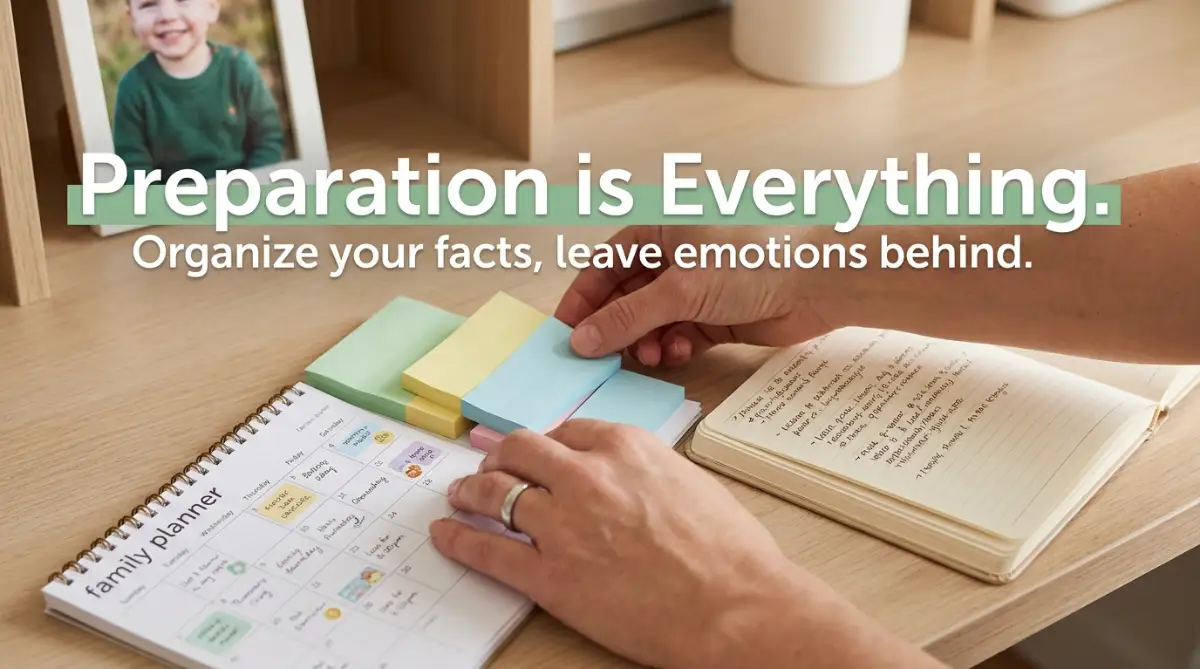
Your Quick Survival Guide (Read This First):
- Treat mediation exactly like a dry, boring business meeting—leave the past arguments at the door.
- Always bring hard data (school calendars, work shifts) instead of emotional screenshots.
- Use "I" statements to dodge fights and keep the focus on what your child needs right now.
- Include a "Right of First Refusal" in your plan to stop future babysitter drama.
Demystifying the Mediation Table
When people hear the word mediation, they often picture a dramatic courtroom scene from a television show. They imagine pointing fingers, loud arguments, and a judge banging a gavel.
In reality, mediation is usually just a quiet conversation in a regular office room. Sometimes, it even happens over a video call from the comfort of your own home.
The main goal here is not to declare a winner and a loser. The true objective is to help two people who know their children best make the decisions, rather than handing that power over to a busy judge.
A mediator is simply a neutral guide. They are not there to take your side, and they are not there to take your ex-partner's side either.
Think of them as a highly skilled referee. Their job is to keep the conversation moving forward when emotions start to get in the way of logic.
Why the Courts Push for Private Agreements
Judges genuinely prefer it when parents figure things out on their own. The court system is heavily overloaded with cases, and judges only get a tiny window into your family's life.
They know that a ruling forced upon a family by a stranger rarely works out perfectly. When parents build their own schedule, they are much more likely to actually follow it.

Research in child psychology heavily supports this approach. Children thrive on stability, and they suffer the most when they witness high levels of conflict between their parents.
When you settle things peacefully, you are giving your child a massive psychological gift. You are showing them that even when things break down, adults can still work together respectfully.
Preparing Your Mindset for the Negotiation Room
Before you gather a single piece of paperwork, you have to get your mind right. Walking into this process with a desire for revenge will automatically set you up for failure.
You have to treat this experience exactly like a high-level business meeting. In a business meeting, you do not yell, cry, or bring up arguments from three years ago.
You stay focused on the project at hand. In this specific case, the "project" is your child’s happiness, safety, and future stability.
I had to learn this the hard way during my own journey. I completely lost my cool when my ex brought up my unpredictable work schedule, and I ended up wasting thirty minutes defending myself instead of discussing the actual calendar. My biggest realization was that the mediator does not care about our past arguments; they only care about how we plan to manage next Tuesday.
To keep yourself grounded, try using a simple visualization technique before you speak. Imagine your child is sitting quietly in the corner of the room listening to every word you say.
Would they be proud of the way you are speaking about their other parent? This simple mental trick works wonders for keeping your temper completely under control.
Want to see exactly how to organize your thoughts before walking into the room? Check out this excellent breakdown of what a winning preparation strategy looks like.
Gathering the Right Kind of Evidence
Many parents make the massive mistake of bringing emotional evidence instead of practical evidence. They bring printed screenshots of angry text messages to prove their ex is a bad person.
The mediator is not a therapist, and they are not there to validate your hurt feelings. They are there to build a functional, working schedule.
Instead of bringing drama, bring data. Bring your child's school calendar, their extracurricular activity schedule, and a list of their doctor's appointments.
Bring copies of your work schedule and a realistic breakdown of your daily availability. When you bring clear data, you immediately look like the more reasonable, organized parent.
Here is a quick breakdown of what to pack in your folder:
- A blank twelve-month calendar to map out holidays.
- Your child's current daily routine and sleeping schedule.
- A list of special needs, medications, or dietary restrictions.
- Three different proposals for a weekly custody schedule.
Always walk in with more than one plan. If you only bring one stubborn demand, you leave absolutely no room for healthy negotiation.
Navigating the Actual Conversation
Once you are sitting at the table, the way you speak matters just as much as what you say. Using "I" statements instead of "You" statements can instantly lower the temperature in the room.
For example, instead of saying, "You always bring him back late," reframe it completely. Say, "I get worried when the transition time is unpredictable, so I would like to establish a firm drop-off window."
This small shift in language removes the personal attack. It forces the other person to respond to the issue, rather than responding to an insult.
It is also incredibly helpful to agree on small, easy things first. Do not start the meeting by arguing over who gets Christmas morning.
Start by agreeing on simpler things, like bedtime routines or who handles dentist appointments. Building a quick streak of agreements creates a positive, cooperative mood in the room.
Steal My "Neutral Response" Script
When your ex sends an angry text trying to start a fight, do not bite the hook. Use my favorite copy-paste response instead:
"I understand you are frustrated about [insert topic]. Right now, I want to keep our focus on the kids' schedule for this week. Let's talk about the rest via email on Monday."
This stops the argument dead in its tracks while keeping you looking like the reasonable adult in the room.
The Myth vs. Reality of Custody Battles
Let us clear up some of the biggest misunderstandings that keep parents awake at night.
Myth: The mother always gets primary custody no matter what.
Reality: Modern family courts heavily favor shared parenting. They look entirely at who has historically provided the care and who can offer the most stable environment moving forward.
Myth: If we cannot agree on one thing, the whole mediation fails.
Reality: You can agree on eighty percent of the parenting plan and only take the remaining twenty percent to a judge. Any agreement is better than zero agreement.
Myth: Children get to choose who they live with once they reach a certain age.
Reality: While a teenager's preference might be considered by a professional, it is rarely the only deciding factor. The adults are always responsible for making the final safe choice.
How to Handle a Deadlock Safely
Sometimes, you will hit a brick wall on a specific topic. Your ex might refuse to budge on a holiday schedule, and you feel your anger rising.
When this happens, do not force the issue until it explodes. Simply ask the mediator to put a pin in that topic and move on to something else.
Taking a five-minute bathroom break can also reset the energy in the room. Step outside, splash cold water on your face, and take three deep breaths.
If you are dealing with a highly difficult or narcissistic personality, you can request "caucus" mediation. This means you and your ex sit in completely different rooms.
The mediator will physically walk back and forth between the two rooms to relay messages. This completely removes the toxic visual triggers and allows you to think clearly.
Focusing on the Long-Term Picture
It is very easy to get stuck fighting over minor details, like who buys winter coats or who pays for a specific soccer camp. Try to zoom out and look at the next ten years of your child's life.
The money you spend fighting over a winter coat in court will end up costing ten times the price of the actual coat. Pick your battles wisely.
Ask yourself if this specific disagreement will matter five years from now. If the answer is no, consider letting it go for the sake of long-term peace.
Building a detailed communication plan is another massive part of the puzzle. Decide right now exactly how you will talk to each other going forward.
Will you only use email for important updates? Will you use a dedicated co-parenting app to track expenses and schedules?
Having a clear rule for communication stops late-night angry texts from happening. It creates a professional boundary that protects your mental health.
When you treat your co-parenting relationship like a professional partnership, everyone wins. Your child gets to see two adults handling a tough transition with grace and maturity.
That sense of security is exactly what you are fighting for. The mediation table is simply the first step in building that beautiful new chapter for your family.
Mastering the Art of Long-Term Co-Parenting Peace
Getting a signed agreement is only the first part of your journey. The real test begins when you walk out of that mediation room and return to your everyday life.
You need a solid, bulletproof strategy to keep the peace long after the mediator goes home. Over the years, I have seen many parents walk away with great plans, only to watch them fall apart because they lacked boundaries.
The secret to long-term success is treating your new parenting schedule like a professional business arrangement. You do not have to be best friends with your ex, but you do have to be excellent project managers together.

The "project" in this scenario is raising a healthy, well-adjusted human being. When you start viewing every interaction through this business lens, your emotional triggers will slowly disappear.
The Right of First Refusal Rule
This is an absolute game-changer that you should always ask to include in your agreement. The "Right of First Refusal" simply means that if one parent needs a babysitter for an extended period, they must offer that time to the other parent first.
Let us say your ex is scheduled to have the kids this weekend, but they suddenly get called into work. Instead of calling their new partner or a random teenage babysitter, they must text you first to see if you want the extra parenting time.
This single rule completely eliminates feelings of jealousy and ensures your child spends maximum time with their actual parents. It builds a beautiful foundation of mutual respect.
Transitioning on Neutral Ground
If picking up your kids from your ex's driveway always ends in an argument, stop doing it. You have the power to change how transitions happen.
Instead of doing drop-offs at a private house, negotiate to do them in a public, neutral location. A local coffee shop, a busy park, or even the school parking lot are excellent choices.
People are naturally much less likely to yell or cause a scene when there are strangers watching them. It also makes the physical hand-off feel much safer and less anxiety-inducing for your child.
You can also design your schedule so that all transitions happen through the school system. One parent drops the child off at school on Monday morning, and the other parent picks them up on Monday afternoon.
This means you and your ex do not even have to see each other during the switch. For high-conflict personalities, this school-based transition method is an absolute lifesaver.
Securing Your Financial Boundaries
Money is often the biggest source of anger after a separation. If you do not outline exactly how extra expenses will be handled, you will end up arguing over every single pair of shoes.
Your parenting plan must clearly state who pays for extracurricular activities, braces, and school trips. Will you split the cost evenly, or will it be based on your income ratio?
When treating your parenting plan like a strict contract, you protect yourself from sudden financial surprises. If your ex signs up your child for expensive hockey lessons without asking you first, the agreement should protect you from being forced to pay for half.
Using a co-parenting app to track these receipts removes the need for awkward phone calls. You just upload the receipt, the app calculates the split, and you move on with your day.
My Top Co-Parenting App Recommendations
If you are tired of arguing over receipts, here is a quick breakdown of the apps that actually work:
- OurFamilyWizard: Best for highly toxic situations (courts love their tone-monitoring feature).
- TalkingParents: Great for keeping a permanent, unalterable record of all your messages.
- AppClose: My favorite free option that still lets you share calendars and track expenses easily.

The Most Dangerous Traps Parents Fall Into
Even with the best intentions, parents easily slip into toxic habits that destroy their hard-earned agreements. If you are not careful, a single bad habit can drag you right back into a messy courtroom.
Understanding these common mistakes is your best defense. Let us walk through the most dangerous pitfalls that can quietly ruin your chances of a peaceful life.
The "Child as a Messenger" Trap
This is arguably the most damaging mistake a parent can make. Do not ever ask your ten-year-old to remind their mother about the child support payment.
Never tell your child to ask their father why he is dating someone new. When you do this, you are forcing a massive, unfair burden onto a tiny pair of shoulders.
According to top experts studying understanding child developmental needs during separation, putting kids in the middle creates severe emotional anxiety. They start feeling like they have to protect one parent from the other.
Adult issues must strictly remain between the adults. If you need to tell your ex something important, you type out a professional email and send it yourself.
The Social Media Venting Trap
We all have moments where we want to scream our frustrations out to the world. However, using Facebook or Instagram as your personal diary is a massive legal mistake.
You might think posting a sarcastic quote about "deadbeat parents" is harmless. I promise you, your ex's lawyer will print that screenshot and use it to prove you are trying to damage their reputation.
Everything you put on the internet is permanent and easily searchable. A judge will not look kindly on a parent who publicly badmouths their former partner.
Keep your venting strictly offline. Talk to a licensed therapist, a trusted best friend, or a private support group, but keep your digital footprint completely clean.
Refusing to Bend the Rules
Some parents treat their custody schedule like a military operation. If the agreement says drop-off is at 5:00 PM, they will completely lose their temper if the other parent arrives at 5:10 PM due to bad traffic.
While holding boundaries is incredibly important, showing zero flexibility will eventually backfire on you. Life happens, tires go flat, and kids forget their homework at the other house.
If you are brutally strict with your ex over minor delays, they will show you the exact same harshness when you inevitably make a mistake. You want to build a little bit of grace into your system.
If they ask to swap weekends so they can take the kids to a special family wedding, try to say yes if it does not ruin your own plans. Building up goodwill in your co-parenting account pays off massively when you need a favor later on.
Introducing New Partners Too Soon
Bringing a new romantic interest into the picture immediately after mediation is a recipe for absolute disaster. Everyone needs time to adjust to the new normal before strangers enter the mix.
Many smart parents write a "Morality Clause" or an introduction timeline directly into their agreement. This rule states that neither parent can introduce a new romantic partner to the kids until they have been exclusively dating for at least six months.
This protects your children from getting attached to a revolving door of casual dates. It also gives your ex-partner time to emotionally cool down before they have to deal with another adult in their child's life.
When you rush introductions, it almost always sparks intense jealousy and new arguments. Take it slow, focus on your kids first, and keep your romantic life private until it becomes truly serious.
Moving Forward Towards a Brighter Chapter
You have walked through the fire of separation, faced your deepest fears at the mediation table, and built a plan to protect your children. That is an incredibly brave and difficult thing to do.
Always remember that the piece of paper you signed is just a map, but you are the one driving the car. Your daily actions, your tone of voice, and your willingness to cooperate will determine how happy your child’s two-home life will be.
Focus entirely on creating a warm, safe, and loving environment in your own house. You cannot control what happens when your kids are with your ex, but you can control the peace they feel when they walk through your front door.
If things start to feel heavy, lean heavily on effective co-parenting communication strategies to reset your mindset. Every time you choose peace over an argument, you are directly investing in your child's mental health.
You have the power to stop generational trauma right here and right now. Keep your head up, stay organized, and watch how beautifully your new life unfolds.
Common Questions About Managing Your Custody Plan
Do I really need to hire a lawyer if we are doing mediation?
You are not strictly required to have a lawyer present in the mediation room. However, it is highly recommended to have a legal professional review the final agreement before you actually sign it. They can spot hidden loopholes that you might have missed during the emotional conversation.
What happens if my ex completely ignores the signed parenting schedule?
Once a judge signs off on your mediated agreement, it becomes a legally binding court order. If your ex refuses to follow it, you can file a motion for contempt of court. Keep detailed records of every missed visit, as you will need this data to prove your case to the judge.
Can we easily change the schedule as our kids get older?
Yes, parenting plans are meant to evolve as your children grow and their needs change. If you both agree on the new changes, you can simply write them up and submit a modified plan to the court for approval. If you cannot agree, you may need to schedule a follow-up mediation session down the road.
How do we handle major medical decisions when we have joint legal custody?
Joint legal custody means both parents have equal say in major life choices, like surgeries, braces, or changing schools. You must discuss these large decisions together before taking any action. For minor, everyday things like treating a basic cold, the parent who currently has the child can make the call.
Will my child have to testify if mediation fails and we go to court?
Family courts work very hard to keep children out of the courtroom to protect their mental health. If the judge really needs to know what the child wants, they will usually ask a professional evaluator to speak with them in a private, friendly setting. If you want to learn more about managing a child's anxiety during transitions, speaking to a pediatric therapist is always a great first step.
It took me a long time to realize that winning an argument with my ex was never worth losing my own peace of mind. I finally found my power when I stopped trying to control their behavior and started focusing entirely on being the best parent I could be. Take a deep breath, trust the boundaries you have built, and step confidently into this fresh new start.
Disclaimer: The information provided in this article is for educational and informational purposes only and should not be considered legal or psychological advice. Family law varies significantly by location. Always consult with a licensed attorney or a qualified mediator in your specific area before making any binding legal decisions regarding child custody.